
5 percent deductible homeowners in Arizona are sitting on a number they’ve never calculated. A 5% deductible sounds like a small number until a monsoon tears off your roof and your carrier tells you the first $25,000 is on you. This is the math most agents never walk through at signing, and it’s the number that makes or breaks a claim.
Key Takeaways:
- On a $400,000 Arizona home with a 5% wind/hail deductible, your out-of-pocket exposure before insurance pays anything is $20,000, not the $500 or $1,000 most homeowners assume.
- Arizona carriers apply percentage deductibles on a per-occurrence basis, meaning every qualifying storm event resets your deductible from zero.
- Buydown endorsements exist on some AZ carrier forms and can reduce a 5% deductible to 1% or 2%, but most homeowners have never been told they can ask for one.
What Is a Percentage Deductible, and How Is It Different From a Flat Deductible?

A percentage deductible is a deductible that calculates against your home’s insured dwelling value, not the size of the claim. This means you could have a $500 claim and a $50,000 claim and owe the exact same deductible amount on both, because the number is tied to your Coverage A limit, not to what the storm actually cost you.
A flat dollar deductible works differently. You agree to pay a fixed amount, say $1,000, and that number stays $1,000 whether the claim is for a broken window or a blown-off roof. It doesn’t move unless you choose to change it.
The percentage structure on a standard Arizona HO-3 policy behaves differently in two ways that catch homeowners off guard. First, the dollar amount grows every time your insured dwelling value grows. If your carrier raises your Coverage A from $400,000 to $450,000 at renewal using their replacement-cost estimator, which most carriers do automatically, your 5% deductible jumps from $20,000 to $22,500. No separate notice required. It’s in the declarations page if you know where to look.
Second, the percentage applies to the full dwelling limit, not the portion of the home that was damaged. Your roof takes a hit from a monsoon wind event. The adjuster scopes $18,000 in damage. Your deductible is calculated against $400,000 in insured value. Those two numbers have nothing to do with each other.
A flat $1,000 deductible stays $1,000 forever. A 5% deductible on a home insured for $500,000 is $25,000, and if the carrier raises your dwelling limit at renewal, that $25,000 goes up too. Understanding this is the starting point for the rest of your arizona homeowners insurance deductible decisions.
The Arizona Math: What a 5% Deductible Actually Costs You at Different Home Values

The numbers below show what you owe before your carrier pays a single dollar on a qualifying wind or hail claim. These are not the claim amounts, these are your deductible amounts at different insured dwelling values across the three most common percentage tiers.
| Insured Dwelling Value | 1% Deductible | 2% Deductible | 5% Deductible |
|---|---|---|---|
| $300,000 | $3,000 | $6,000 | $15,000 |
| $400,000 | $4,000 | $8,000 | $20,000 |
| $500,000 | $5,000 | $10,000 | $25,000 |
| $600,000 | $6,000 | $12,000 | $30,000 |
| $750,000 | $7,500 | $15,000 | $37,500 |
The $400,000 row is the one to anchor on. It represents a mid-range Phoenix-metro home, and at a 5% wind/hail deductible, the homeowner owes $20,000 before the carrier contributes anything. At 1%, that same home carries a $4,000 deductible, still not nothing, but a number most households can absorb without financing a repair.
That gap between $4,000 and $20,000 is not a coverage difference. The policy language is the same. The peril is the same. The difference is one number on the declarations page that most homeowners never asked about.
AZ carriers re-rate dwelling limits at renewal using replacement-cost estimators, and those estimators have been running hot since 2021 due to construction cost inflation. A home that was insured at $400,000 two years ago may now be insured at $460,000 or $490,000. At 5%, that’s a deductible of $23,000 to $24,500, and the homeowner’s annual premium statement reflects this as a coverage increase, not as a deductible increase. Most people read the premium line and stop there.
For a full picture of why these limits keep climbing, the arizona insurance guide covers the replacement-cost crisis driving carrier behavior statewide.
Is the Deductible Per Claim or Per Year on Arizona Home Insurance?

The percentage deductible on an Arizona homeowners policy applies per occurrence. Each qualifying storm event triggers a separate, full deductible. There is no annual aggregate cap on a standard Arizona HO-3.
This matters most during monsoon season. Arizona runs roughly 90 days of active storm exposure from mid-June through mid-September. Two separate storm events in that window are not unusual. A microburst in July and a wind event in August are two occurrences. If your home takes damage in both, you pay the percentage deductible twice.
On a $400,000 home with a 5% wind and hail percentage deductible, two qualifying events in a single summer mean $40,000 in total deductible exposure before the carrier contributes a dollar to either claim. That is not a hypothetical edge case. That is what the policy says, and it’s what the adjuster will tell you when you call.
Some specialty structures and excess-layer products do use aggregate caps, but those are not standard Arizona HO-3 features. If your policy doesn’t say “aggregate” on the declarations page, it doesn’t have one. The wind hail percentage deductible resets clean after every covered occurrence.
The consumer assumption that runs counter to this is the flat-deductible mental model. With a $1,000 flat deductible, most people intuitively think of it as an annual threshold. That’s not even technically accurate for flat deductibles, but it’s close enough in practice because storms rarely produce two separate claims that both get filed in one year. With a 5% percentage structure, the per-occurrence application is the mechanism that makes the math punishing, and it’s the mechanism that almost no one explains at the point of sale.
For context on related coverage gaps where the per-occurrence structure creates similar surprises, the coverage analysis on arizona uninsured motorist property damage shows how per-incident calculations catch drivers off guard in the same way.
The Monsoon-Claim Shock Scenario: How Arizona Homeowners Find Out the Hard Way
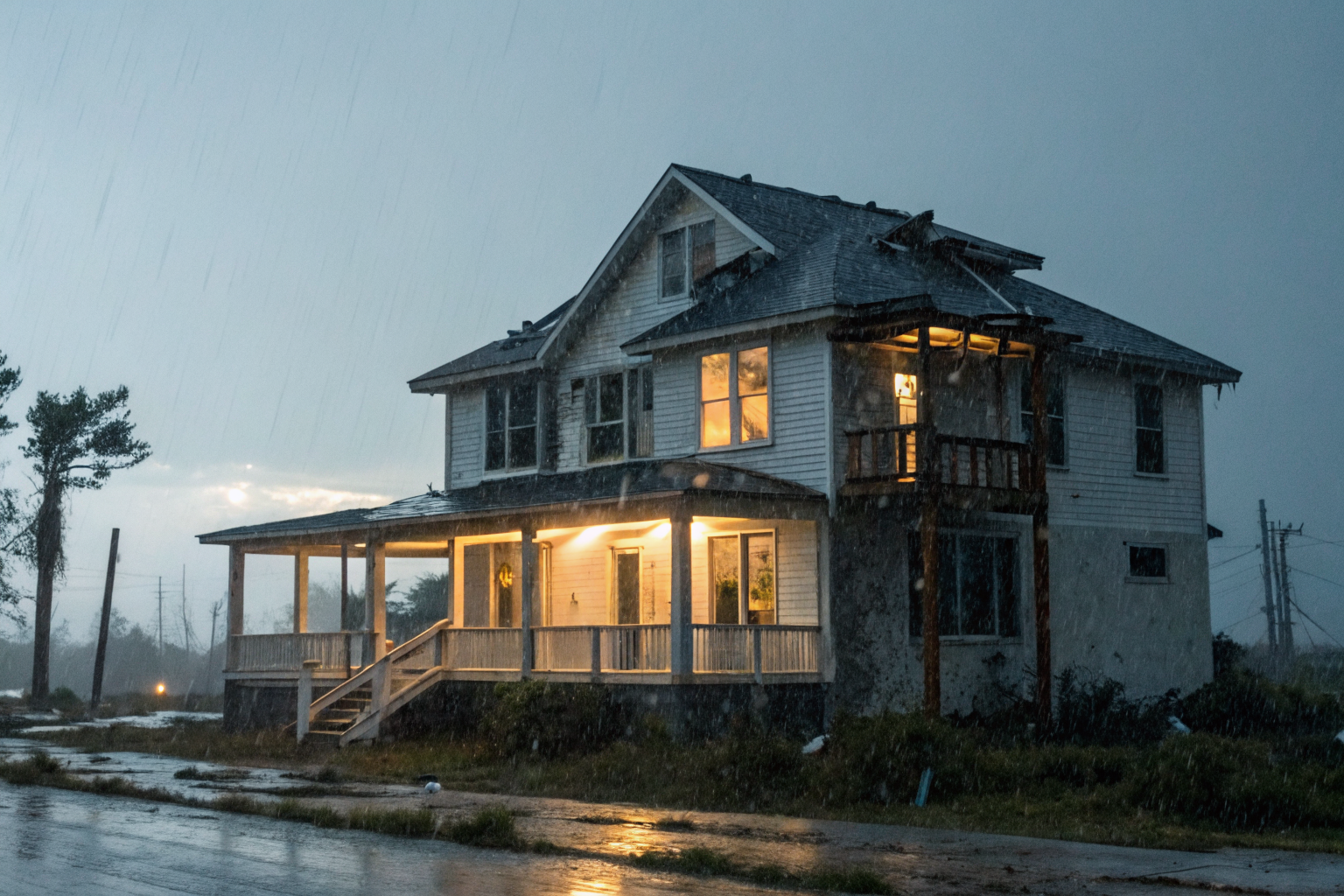
The monsoon wind damage claim triggers a percentage deductible that most AZ homeowners have never calculated before they file. Here is how it goes:
A monsoon storm peels up the tile underlayment on a $400,000 home and drives water through the roof deck into the ceiling and walls below. The homeowner calls the carrier the next morning.
The homeowner expects a $1,000 flat deductible, because that’s what they remember from signing the policy seven years ago, and no one called to explain the change.
The adjuster scopes the damage: torn underlayment, saturated insulation, drywall damage in two rooms. Total repair estimate comes in at $18,000.
The carrier applies the 5% wind/hail deductible against the insured dwelling value of $400,000. The deductible is $20,000.
The carrier pays nothing. The damage estimate of $18,000 falls below the $20,000 deductible. The claim closes with a zero payment to the homeowner.
The homeowner pays the full $18,000 repair bill out of pocket, files a claim that now sits on their loss history, and discovers that their coverage for the next renewal may be affected by the filed claim, even though the carrier paid nothing.
The claim was legitimate. The coverage was real. The policy did exactly what it said it would do. The deductible structure made the payout zero.
AZ ranks third nationally in non-weather water damage costs (Insurance Information Institute), and monsoon-driven roof-to-interior water paths are one of the common drivers of that figure. A percentage deductible can render a legitimate $15,000 to $18,000 storm-water claim a zero-payout event. This isn’t a denial, it’s a deductible problem. But from the homeowner’s side, the result is identical.
For more on how water damage claims get resolved (and rejected) in Arizona, the coverage on cant get homeowners insurance arizona shows how claim history from filed-but-unpaid losses feeds into carrier non-renewal decisions.
Can You Buy Down a High Percentage Deductible, and What Does It Cost?

A deductible buydown endorsement reduces a percentage deductible from 5% to 1% or 2% on eligible Arizona policies. This is a carrier add-on that lets you pay a higher annual premium in exchange for a lower deductible tier. Most homeowners have never been offered one because most agents don’t bring it up.
Here is what you need to know before your next renewal:
A buydown endorsement is a paid add-on, not a built-in option. You pay more premium annually to lower the deductible percentage. The trade is straightforward: a higher known cost each year against a lower unknown cost at the time of a claim.
Not every Arizona carrier offers this on every policy form. Availability depends on the carrier’s filed form, the age and condition of your roof, and your home’s location and risk profile. Some carriers that offered buydowns two years ago have pulled the endorsement from new and renewal business.
The typical paths run from 5% down to 2%, or from 2% down to 1%. Getting back to a flat dollar deductible from a percentage structure is rare on current AZ market forms. You are buying a reduction in percentage, not an elimination of the structure.
Evaluate the buydown by comparing dollar amounts, not percentages. On a $400,000 home, going from 5% to 2% drops your deductible exposure from $20,000 to $8,000. If the endorsement costs $300 per year in additional premium, you break even after one claim in roughly 40 years of paying the difference. One storm event in year two makes the buydown the right call.
Ask at renewal, not after a storm. Carriers will not allow a deductible change mid-term, and they will not allow a buydown after a loss event has been reported. The conversation has to happen before the claim.
Roof age is a qualifying factor. A home with a tile roof over 20 years old may be ineligible for a buydown endorsement entirely. Replacing an aging roof eliminates the 25-50% age surcharge carriers apply to homes with roofs over 20 years old, and a new roof can also reopen eligibility for buydown endorsements that were previously unavailable.
If you want to understand why roof condition affects your options this much, the analysis on wind hail percentage deductible breaks down how carrier underwriting treats roof age as a pricing and eligibility variable.
For homeowners already looking at limited market options, the path described in cant get homeowners insurance arizona also covers how surplus lines carriers handle percentage deductible structures differently from admitted carriers.
Frequently Asked Questions
What does a 5% deductible mean on home insurance?
A 5% deductible on home insurance means you pay 5% of your home’s insured dwelling value out of pocket before the carrier pays anything on a qualifying claim. On a $400,000 home, that is $20,000. The percentage applies to the insured value, not to the size of the claim, a $10,000 storm repair and a $60,000 storm repair carry the same $20,000 deductible on that home.
Is homeowners insurance deductible per claim or per year in Arizona?
In Arizona, the percentage deductible on a standard HO-3 policy applies per occurrence. Each qualifying storm event triggers a separate deductible from zero. Two monsoon events in the same summer mean two separate deductible payments, there is no annual aggregate cap on a standard Arizona HO-3 policy.
What percentage deductible is normal for Arizona home insurance?
Wind and hail percentage deductibles on Arizona homeowners policies run from 1% to 5% of the insured dwelling value, depending on the carrier, roof age and type, and the home’s location. A 2% deductible is common on newer or recently re-roofed homes. Carriers are pushing 5% deductibles on older roofs and higher-risk zip codes. Your renewal declarations page shows the current percentage, check it before you assume it hasn’t changed.