
Motorcycle insurance Arizona riders carry is governed by the same financial responsibility statute as auto, but the riding rules, the gear rules, and the coverage gaps are their own category. As of 2025, Arizona adults can ride without a helmet and face no registration requirement for e-bikes, yet both of those facts create insurance exposures most riders don’t discover until after a claim.
Key Takeaways:
- ARS 28-964 removes the helmet requirement for riders 18 and older, but most AZ motorcycle liability policies treat the helmetless rider as a higher medical-cost risk, expect that to show up in your premium math.
- Arizona’s minimum motorcycle liability limits mirror auto at 25/50/15 under ARS 28-4009, which means a single at-fault crash with injuries can exceed your coverage by tens of thousands of dollars.
- Class 1, 2, and 3 e-bikes are excluded from Arizona’s motorcycle insurance statute, riding an e-bike that crosses into moped territory leaves you in a coverage gap most personal auto and homeowners policies won’t fill.
This article is part of the broader arizona insurance guide for Phoenix-metro and statewide AZ riders. If you need the homeowners insurance arizona context for how your bike intersects with your property coverage, that cluster covers the overlap. For auto coverage mechanics that share the same statutory framework, the auto insurance arizona article is the right companion read.
What Arizona Actually Requires for Motorcycle Insurance

An Arizona motorcycle liability policy is the financial instrument that satisfies the state’s proof-of-responsibility requirement for titled, engine-powered two-wheelers. This means that before you register a motorcycle with the Arizona Department of Transportation, you need a policy that meets the minimum liability thresholds set by statute.
Per ARS 28-4009, Arizona motorcycle liability requires minimum limits of 25/50/15. In plain language: $25,000 per injured person, $50,000 per accident across all injured parties combined, and $15,000 for property damage. Those three numbers are identical to the state’s auto minimums. The underlying financial responsibility obligation comes from ARS 28-4033, which requires proof of coverage before a vehicle can be registered and operated on public roads.
What those numbers mean in practice is worth pausing on. A single pedestrian struck at a crossroads could generate $80,000 in emergency care alone. A multi-vehicle collision in Phoenix metro can produce injuries across several people simultaneously. The 25/50/15 floor keeps you legal. It does not keep you financially protected against a serious at-fault crash.
The statutory minimums apply to titled, engine-powered motorcycles covered by the motorcycle financial responsibility framework. They do not apply to e-bikes, which the Arizona Revised Statutes classify as a separate vehicle category. That distinction has real coverage consequences covered in its own section below.
One thing most guides skip: ARS 28-4033 requires that proof of financial responsibility be maintained continuously, not just at the point of registration. A lapsed policy mid-year is a statutory violation, not just an insurance gap.
Consult a licensed AZ insurance agent for advice specific to your situation before selecting limits or coverage types. The minimums described here reflect current statutory floors, not recommendations for what any individual rider should carry.
Does Arizona Require a Motorcycle Helmet?

ARS 28-964 removes the helmet requirement for riders and passengers 18 years and older. Riders under 18 are required to wear a helmet. That is the full legal picture.
The insurance picture is different. Carriers underwrite motorcycle policies against expected medical costs, and head injury claims skew those costs upward. NHTSA has published motorcycle fatality and injury data consistently showing that helmets reduce fatality risk, the agency notes this finding across multiple annual Traffic Safety Facts reports. The specific percentage varies by study year and crash type, but the directional relationship between helmet use and medical severity is well-established in the NHTSA data set.
Where that matters to your policy: some carriers ask about helmet use during the application process and factor it into their underwriting model. A helmetless rider isn’t breaking the law, but may be paying more for coverage, or may find that medical payments (MedPay) coverage and uninsured motorist coverage become more expensive to carry because the carrier prices the expected claim cost higher.
MedPay coverage pays your medical bills regardless of fault. Uninsured motorist coverage under ARS 20-259.01 pays when the driver who hit you has no insurance or insufficient limits. Both become more load-bearing when you ride without a helmet, because the potential claim amount is higher.
The practical takeaway: if you ride helmetless, review your MedPay limit and your UM/UIM limits specifically. The legal optionality of not wearing a helmet does not translate to an insurance optionality on those two coverage lines.
Arizona Motorcycle Coverage Options Compared: What Each Layer Actually Does

An Arizona motorcycle liability policy consists of multiple distinct coverage layers beyond the statutory minimum. The base liability requirement gets you on the road legally. The layers beneath it are what protect you, your bike, your gear, and anyone who hits you without coverage.
| Coverage Type | What It Pays | Why AZ Riders Need It | Common Gap |
|---|---|---|---|
| Liability (Bodily Injury + Property Damage) | Injuries and property damage you cause to others | Required by ARS 28-4009; minimum 25/50/15 | Minimums are often too low for a serious at-fault crash in Phoenix metro |
| Uninsured/Underinsured Motorist (UM/UIM) | Your injuries when the at-fault driver has no insurance or too little | ARS 20-259.01 requires carriers to offer it; AZ has a high uninsured driver rate | Riders often waive it to save money, then find out why that was a mistake |
| Medical Payments (MedPay) | Your medical bills regardless of fault | Pays before health insurance kicks in; critical for helmetless riders | Low default limits ($1,000-$5,000) may not cover a single ER visit |
| Accessory Coverage | Custom parts, aftermarket additions, riding gear | Most base policies cap accessories at $3,000; year-round AZ bikes often exceed that | Custom exhaust, GPS, upgraded seats, and gear add up fast |
| Trip-Interruption Coverage | Lodging and transport if the bike is damaged or breaks down far from home | AZ riders travel year-round; a breakdown 200 miles from Mesa is a real scenario | Rarely included in base policies; must be added as an endorsement |
| Comprehensive | Theft, weather damage, fire, falling objects | Monsoon haboobs and flood debris are AZ-specific hazards | Not required but hard to skip on a financed or high-value bike |
| Collision | Damage to your bike when you hit something or are hit | Pays regardless of who caused the accident | Deductible selection affects out-of-pocket cost significantly |
The accessory coverage cap deserves direct attention. Most base AZ motorcycle policies cap accessory coverage at $3,000, a figure that gets consumed by aftermarket exhaust, custom seats, GPS units, and riding gear on a bike that’s ridden 12 months a year. If you’ve added anything to the bike after purchase, check whether your current limit matches the actual value on the road.
Trip-interruption coverage is the layer most guides miss entirely. It pays lodging and transport costs when your bike is immobilized far from home due to damage or mechanical failure. For riders who use their motorcycle as a primary vehicle or take long routes through the desert, that endorsement matters more in Arizona than in states where rides stay close to home.
For riders also navigating business coverage questions, the business insurance arizona framework has its own commercial auto layer that applies when a motorcycle is used for business purposes.
The E-Bike Insurance Gap: What Arizona Law Doesn’t Cover
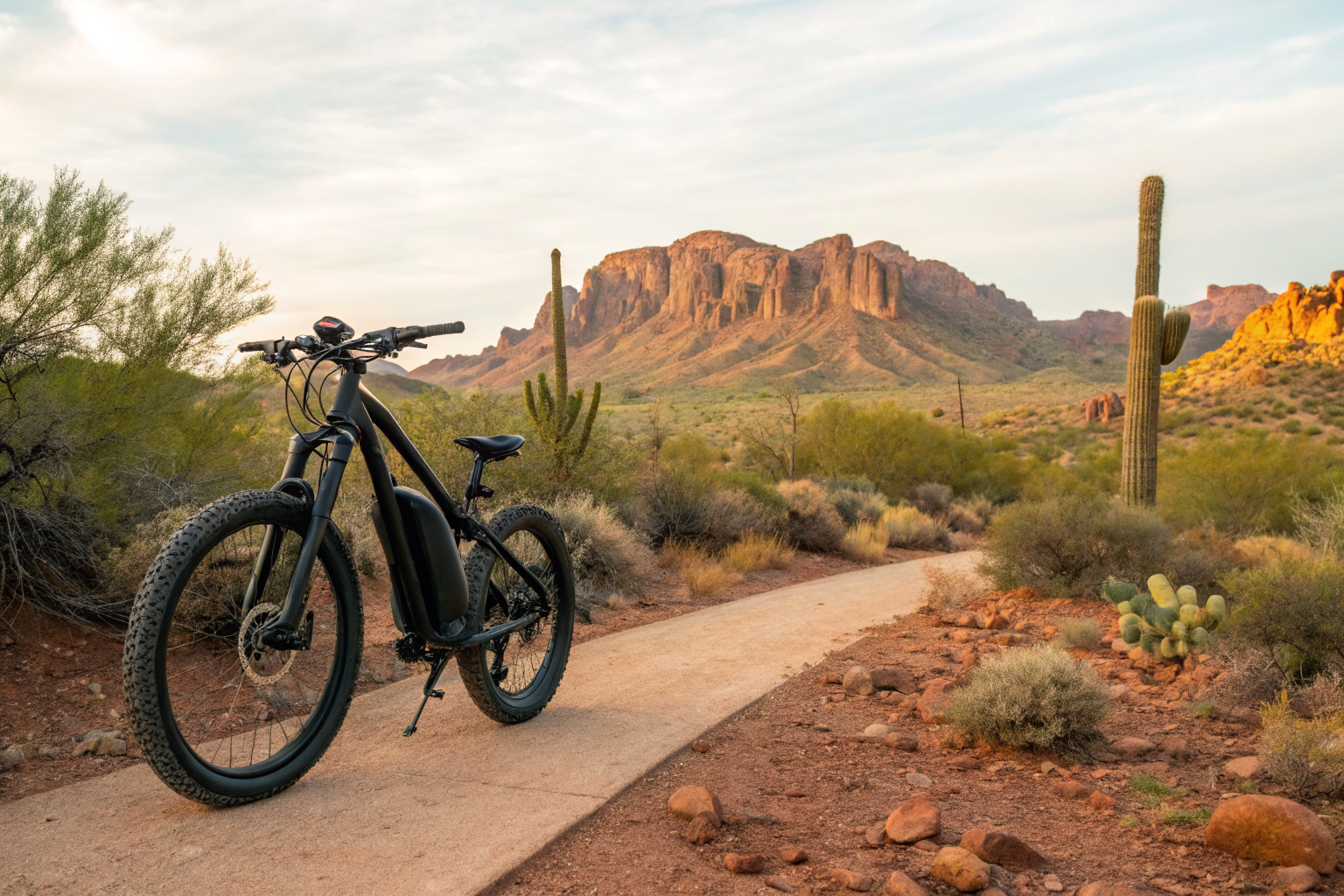
An Arizona e-bike classification is a vehicle designation under ARS 28-101 that places electric bicycles into three classes, all of which are separate from motor-driven cycles and mopeds. This means none of the three classes trigger the motorcycle financial responsibility statute, and no standard insurance requirement fills that space.
The three classes under ARS 28-101 break down as: Class 1 provides pedal-assist up to 20 mph with no throttle, Class 2 adds throttle-assist up to 20 mph, and Class 3 provides pedal-assist up to 28 mph. None require motorcycle registration. None require motorcycle insurance.
The gap opens when you look at what else doesn’t cover you. A personal auto policy typically excludes e-bikes from its liability and collision provisions. A homeowners insurance HO-3 policy may cover the e-bike as personal property against theft or fire, but the HO-3 form excludes liability arising from motorized vehicles in most standard filings. If you injure a pedestrian while riding a Class 3 e-bike, your HO-3 policy is not the coverage that responds. A Business Owner’s Policy (BOP) won’t apply unless the e-bike is used in the course of business operations, and even then, the commercial auto provisions may exclude it depending on the form.
The result: an e-bike rider who causes an injury may have no liability coverage in place at all. Specialty e-bike insurance products exist in the market, but they are not automatically packaged with any standard homeowners, auto, or commercial policy.
If you own a Class 2 or Class 3 e-bike and ride it in public, ask your agent directly whether your existing coverage includes e-bike liability. Don’t assume the answer is yes. The statutory classification that keeps e-bikes out of the motorcycle registration system is the same one that keeps them out of the standard insurance framework.
Year-Round Riding in Arizona: How 12 Months of Exposure Changes Your Premium Math

Arizona’s year-round riding season increases cumulative exposure relative to seasonal-riding states, and carriers price that difference into motorcycle premiums. A rider in Minnesota garages their bike from October through April. A Phoenix metro rider logs miles every single month. Phoenix metro averages more than 300 sunny days per year according to National Weather Service data, a riding window roughly three times longer than northern states where bikes sit idle for six months.
Here is what that means for your coverage decisions:
No lay-up discount applies. Carriers in cold-weather states often reduce premiums for months when a bike is stored and not ridden. Arizona riders don’t qualify for that reduction because there is no off-season. Your annual premium reflects 12 months of active exposure.
Higher mileage accumulation increases comprehensive and collision exposure. More miles means more opportunities for an at-fault accident, a collision with debris, or damage from road hazards. Carriers look at annual mileage estimates when pricing your policy.
Monsoon season (June through September) adds a distinct weather-risk window. Rain on hot asphalt, haboob dust storms, and flash-flood debris on desert roads generate real comprehensive claims. This is not a theoretical risk. AZ riders who carry only liability find out its limits during monsoon season.
Phoenix metro summer heat above 110°F accelerates tire wear and mechanical stress. A bike that fails 150 miles from home in August heat is a different problem than a flat tire near your neighborhood. Trip-interruption coverage addresses that scenario directly.
Year-round commuting means more exposure to uninsured drivers. More riding days equals more days sharing the road with the portion of Arizona drivers who carry no insurance. UM/UIM coverage under ARS 20-259.01 becomes more valuable the more you ride.
Winter snowbird season (November through April) increases out-of-state driver traffic. Drivers unfamiliar with Phoenix metro interchanges and desert road conditions add a measurable risk variable during the months most other states have reduced road traffic.
Review your policy annually. AZ riding patterns don’t follow the seasonal reset that most underwriting models are built around in other states. If your policy was priced to a lower mileage estimate than you’re logging, the gap between estimated exposure and actual exposure may matter at claim time. For riders also managing property coverage, the non renewal notice process in Arizona is worth understanding separately if your insurer changes appetite mid-policy.
Riders who operate from the Chandler or East Valley area and want a policy review from a licensed agent can reach out through the insurance agency chandler az contact pathway. The same year-round exposure math applies whether you’re commuting in Mesa or riding routes toward Payson.
Note: if you also manage a commercial vehicle or a flat-roof property alongside your bike, monsoon risk assessment runs across both exposures. The commercial flat roof monsoon damage framework is a separate analysis, but the weather window is the same.
Frequently Asked Questions
What is the cheapest legal motorcycle insurance in Arizona?
The cheapest legal option is the state minimum: 25/50/15 liability under ARS 28-4009, with no other coverage required. That breaks down to $25,000 per injured person, $50,000 per accident total, and $15,000 in property damage. The minimum is legal, but a single at-fault injury crash in the Phoenix metro can exceed those limits fast, consider whether minimum limits protect your assets before choosing on price alone.
Do I need insurance for my e-bike in Arizona?
Arizona does not require insurance for Class 1, 2, or 3 e-bikes under the motorcycle financial responsibility statute. That means no required coverage exists if you injure someone while riding. Your HO-3 homeowners policy may cover the e-bike as personal property but typically excludes liability from motorized vehicles. Ask your agent specifically about e-bike liability before assuming any existing policy covers you.
Is it legal to ride a motorcycle without a helmet in Arizona?
Yes, for riders and passengers 18 and older, ARS 28-964 makes helmet use optional in Arizona. Riders under 18 are required to wear a helmet. The legal option to ride without a helmet doesn’t change how carriers evaluate medical-cost risk, so helmetless riders should pay particular attention to their MedPay and UM/UIM limits.
The information in this article reflects Arizona statutes and insurance principles as of 2025. For advice specific to your policy, riding pattern, or coverage needs, consult a licensed Arizona insurance agent.