
Flash flood insurance Arizona homeowners actually need is almost never the policy sitting in their file cabinet. As of 2025, standard homeowners policies exclude flood damage by definition, and that gap catches people off guard every monsoon season. This guide is part of a broader arizona insurance guide covering the coverage gaps that cost AZ homeowners the most.
Key Takeaways:
- Standard Arizona HO-3 homeowners policies exclude all flood damage by definition, flash floods included, regardless of how fast the water moved or where it came from.
- The only policy that covers flood damage in Arizona is an NFIP-backed flood policy or a private flood endorsement; NFIP policies carry a 30-day waiting period before coverage activates.
- Maricopa County has more than 5,000 miles of washes and arroyos, and properties within FEMA-designated Special Flood Hazard Areas are required by most mortgage lenders to carry an NFIP flood policy under federal law.
What ‘Flash Flood’ Actually Means, and Why the Definition Kills Your Claim

A flood, as insurers define it in filed policy language, is a general and temporary inundation of normally dry land caused by surface water, overflow of any body of water, runoff, or mudflow. This means the word “flood” in your policy exclusion is far wider than most people think, it captures the street water that rushed under your front door just as surely as it captures a river that overflows its banks. Flash flood damage is excluded from standard Arizona HO-3 homeowners policies the same as any other flood event.
The speed of the water does not matter to the exclusion. That is the part most people miss.
AZ monsoon season runs June 15 through September 30, per the National Weather Service. During that window, intense rainfall can generate flash-flood conditions in under ten minutes across the Phoenix metro. The HO-3 flood exclusion does not distinguish between water that rose over three days and water that rose in three minutes. FEMA defines “flood” in the Standard Flood Insurance Policy as “a general and temporary condition of partial or inundation of two or more acres of normally dry land area or of two or more properties”, and the ISO flood exclusion language used in most HO-3 forms, including the HOAIC Arizona HO-3 form filed with DIFI in March 2025, is written to capture all of those scenarios.
The practical implication is brutal. A homeowner who describes the event as “water came under the door” rather than “flood” is still denied when the adjuster traces the source back to surface water runoff. The framing of the claim does not override the origin of the water. Consult a licensed insurance agent for advice specific to your property and your current policy language before monsoon season, not after a claim is already in dispute.
The Water-Came-Under-the-Door Problem: How the Gap Plays Out

Arizona homeowners mistake monsoon surface-water intrusion for a covered water-damage event more often than any other claim scenario in this category. Here is the sequence: a monsoon storm hits, street drainage gets overwhelmed, water flows across the lot and enters through the front door threshold or garage door gap. The homeowner calls their agent. The adjuster comes out, identifies the source as surface water runoff from outside the structure, and denies the claim under the flood exclusion. The homeowner is stunned.
The line adjusters draw is specific. Water that originates from inside the home, a burst pipe, a water heater failure, an appliance overflow, is covered under a standard HO-3 as a sudden and accidental discharge. Water that enters from outside the structure as surface water or overflow from any external source is excluded. That line holds regardless of how the homeowner describes the event.
The Insurance Information Institute notes that flood damage is the most common and costly natural disaster type in the United States, yet standard homeowners policies exclude it across the board, a gap FEMA estimates affects millions of properties nationally. AZ homeowners are not a special case; the exclusion is universal.
One specific confusion worth naming: the hidden water damage endorsement is not flood coverage. Some AZ homeowners add that endorsement after hearing about water-damage claim denials and believe they are now protected against monsoon intrusion. They are not. That endorsement covers slow internal leaks that cause hidden damage over time, think a slow drip behind a wall. It does not cover surface water entering from outside. Those are different perils, different endorsements, and different claim outcomes.
If you are uncertain whether you need flood insurance in Phoenix specifically, that question deserves its own look before you decide to skip coverage, the risk profile of a flat Phoenix-metro lot near a wash is different from a hillside property with good drainage.
Speak with a licensed agent before monsoon season. The conversation takes less than an hour and the claim denial takes years to get over.
Does Flood Insurance Cover Flash Floods, and What Does an NFIP Policy Do?

Yes. An NFIP-backed flood policy covers flash flood damage. Flash floods qualify as flood events under NFIP’s definition, rapid-onset surface water inundation of normally dry land is exactly what the program was built to cover. The speed of onset does not disqualify the claim.
NFIP flood policies → cover flash flood damage → to Arizona structures and contents up to the limits below.
FEMA administers the NFIP. Arizona homeowners can look up their property’s flood zone designation at FEMA’s Flood Map Service Center at msc.fema.gov.
| Feature | NFIP Flood Policy |
|---|---|
| Building coverage maximum (residential) | $250,000 |
| Contents coverage maximum | $100,000 (purchased separately) |
| Additional Living Expenses / temporary housing | Not covered |
| Vehicles | Not covered |
| Basement contents (most categories) | Not covered |
| Landscaping and outdoor property | Not covered |
| Currency, precious metals | Not covered |
| Waiting period before coverage activates | 30 days (standard) |
| Who administers it | FEMA / Write-Your-Own participating carriers |
| Where to buy | Through a licensed insurance agent |
The 30-day waiting period is the detail that trips people up most. A policy purchased the morning before a storm does not respond to that storm. FEMA built the waiting period specifically to prevent people from buying coverage only when a storm is imminent.
The contents coverage gap is the other common mistake. NFIP building coverage maximum is $250,000 for a residential structure. Contents coverage maximum is $100,000, and you must buy it as a separate policy. Many homeowners purchase building coverage only and find out after a claim that their furniture, appliances, and personal property have no flood coverage at all.
Private flood insurance is a real alternative worth knowing about. Private carriers can offer higher building and contents limits than NFIP maximums, shorter waiting periods in some cases, and Additional Living Expense coverage that NFIP does not provide. A licensed agent can shop private flood options alongside NFIP and compare them against your specific property’s risk profile.
Maricopa County Washes, Arroyos, and Flood Zones: Do You Need Flood Insurance in Arizona?
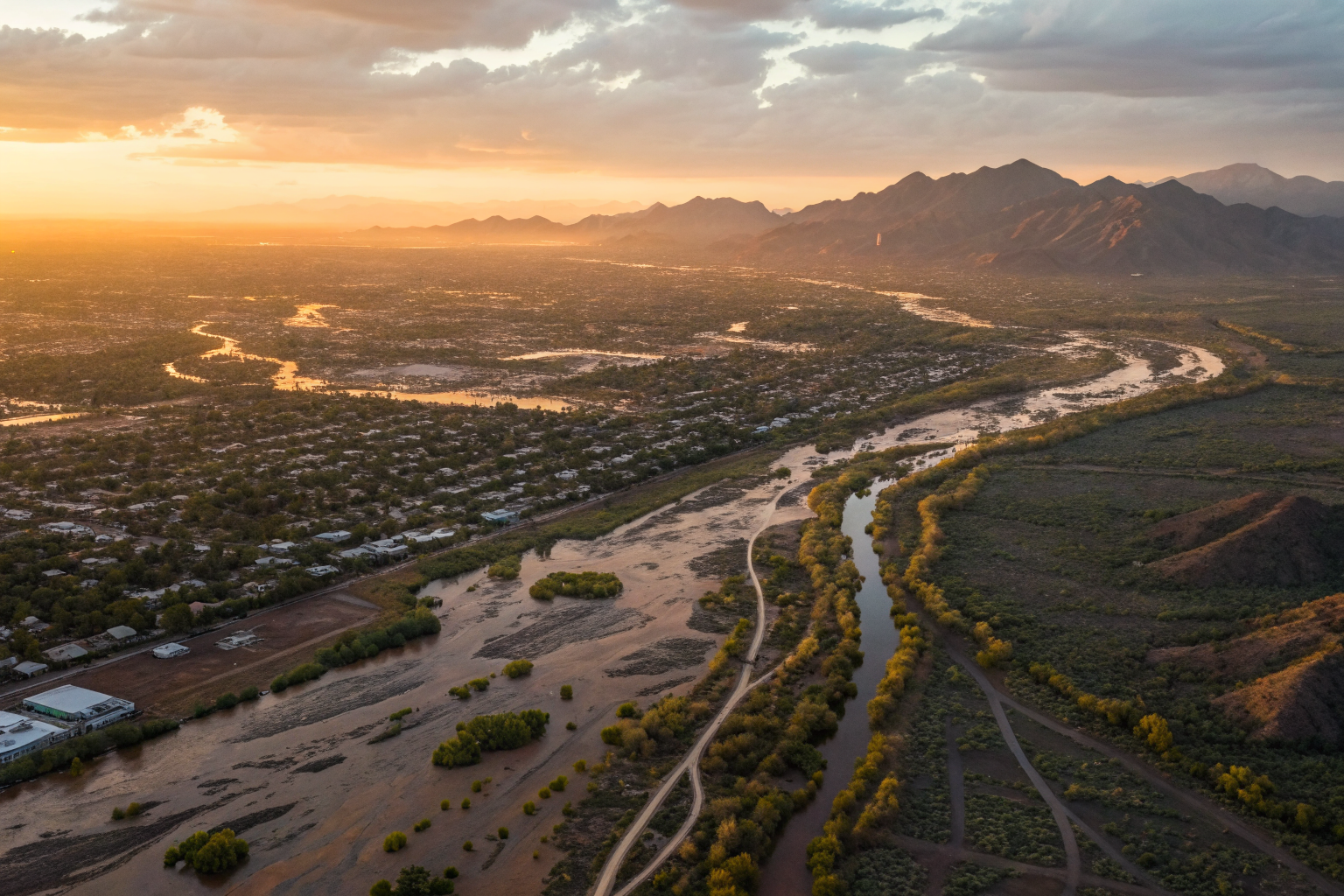
Maricopa County wash and arroyo proximity increases flash flood risk for Arizona homeowners who may not carry any NFIP coverage, and the mapped flood zones do not tell the whole story. FEMA maps are updated on irregular cycles, and development patterns in the Phoenix metro have changed drainage behavior in ways that older maps do not reflect.
Here is how to think through whether flood insurance makes sense for your property:
Your lender requires it. Federal law mandates flood insurance for properties in FEMA-designated Special Flood Hazard Areas (SFHAs, Zone A or Zone AE) when the mortgage is federally backed. This is not optional. Your lender will force-place a policy and charge you for it if you let yours lapse.
Your property sits within a quarter-mile of a wash or arroyo. Maricopa County contains thousands of miles of natural washes and arroyos. Properties near those drainageways carry meaningful flash-flood exposure even when FEMA has not mapped them into a high-risk zone, because FEMA flood maps are not always current with development and channel changes.
Your lot is low-lying or near street drainage infrastructure. Flat Phoenix-metro streets can sheet-flow water toward specific properties during a monsoon event regardless of the official FEMA zone designation. The lot’s physical position relative to drainage matters as much as the map.
Your property is in Zone X (low to minimal flood hazard). Flood insurance is available and often inexpensive for Zone X properties. According to FEMA, roughly 25% of all NFIP claims come from properties outside FEMA-designated high-risk flood zones. Low-risk does not mean no-risk.
You rent the property. Renter’s insurance excludes flood damage the same as an HO-3. Renters in flood-prone areas or near washes should consider NFIP contents-only coverage, the building is the landlord’s problem, but the furniture and electronics are yours.
Check your property’s flood zone designation at FEMA’s Flood Map Service Center before monsoon season starts. Then talk to a licensed agent about whether your specific lot’s position warrants a policy. The map gives you the zone; the agent gives you the risk picture the map misses.
How to Get Flash Flood Coverage in Arizona: Your Options Side by Side
Arizona homeowners can obtain flash flood coverage through NFIP policies or private flood endorsements, those are the two real paths. The third option, carrying no flood coverage, is a legitimate choice some low-risk properties make with full awareness of the exposure. What is not a legitimate option is assuming the HO-3 covers it. It does not, regardless of how the claim is framed.
| Feature | NFIP Standard Flood Policy | Private Flood Insurance | No Flood Coverage |
|---|---|---|---|
| Who administers it | FEMA / Write-Your-Own carriers | Private insurance carriers | N/A |
| Building coverage maximum | $250,000 | Often higher than $250,000 | None |
| Contents coverage maximum | $100,000 (separate policy) | Varies by carrier | None |
| Additional Living Expenses | Not covered | Some carriers offer it | None |
| Waiting period | 30 days (standard) | Varies, some as short as 14 days | N/A |
| Where to buy | Through a licensed agent | Through a licensed agent | N/A |
| Rough annual cost (Zone X, low-risk AZ property) | Often below NFIP national average of $700-$800 | Varies; elevation certificate data affects pricing | $0 premium, full exposure |
| Flash flood claims covered | Yes | Yes | No |
NFIP national average annual premium runs approximately $700-$800 per year according to FEMA. Zone X properties in Arizona often pay below that average because their risk profile is lower. Private flood market premiums vary based on elevation certificate data and individual carrier appetite, some properties get better terms in the private market, some do not.
The action steps are straightforward. First, look up your FEMA flood zone at msc.fema.gov. Second, talk to a licensed agent who can pull both NFIP pricing and private flood options for your address and compare them side by side. The Gebhard Agency has access to 200+ carriers and can show you both options against your specific property’s risk. Third, if monsoon season is approaching, buy now, the 30-day NFIP waiting period means waiting until a storm is in the forecast is too late.
For advice specific to your property, consult a licensed insurance agent before making a coverage decision.
Frequently Asked Questions
Is flash flooding covered by homeowners insurance in Arizona?
Standard Arizona HO-3 homeowners policies exclude all flood damage, including flash floods, regardless of how fast the water rose or where it originated. The exclusion applies to surface water, overflow from any body of water, and runoff, the exact conditions that generate flash flooding during AZ monsoon season. Only a separate NFIP flood policy or private flood endorsement covers this exposure.
Does flood insurance cover flash floods specifically, or just slow-rising river floods?
An NFIP flood policy covers flash floods the same as any other flood event. FEMA defines flood broadly as a general and temporary inundation of normally dry land, which includes rapid-onset flash flooding. The speed of the water does not affect whether the claim is covered, what matters is that you have an active flood policy with the 30-day waiting period already satisfied before the event occurs.
Do I need flood insurance if I’m not in a flood zone in Arizona?
You are not legally required to carry flood insurance unless your property sits in a FEMA-designated Special Flood Hazard Area and you have a federally backed mortgage. That said, FEMA data shows roughly 25% of NFIP claims come from outside high-risk zones, and Maricopa County’s extensive wash and arroyo network means flash-flood exposure exists well beyond mapped boundaries. Zone X flood policies are often inexpensive, talking to a licensed agent about your specific lot’s risk before monsoon season is worth the time.