
Is my ebike covered by homeowners insurance in Arizona? The short answer is: it depends on what class of e-bike you own, and most riders don’t find out they’re in the wrong column until after a theft or an injury claim gets denied. As of 2025, standard Arizona HO-3 policy forms draw a hard line between a bicycle and a motorized vehicle, and that line falls right across the e-bike market.
Key Takeaways:
- Most standard Arizona HO-3 policies cover e-bikes for theft up to the personal property sub-limit, typically $1,500 or less, but exclude liability if the bike exceeds Class 1 or Class 2 thresholds.
- A Class 3 e-bike (top assisted speed of 28 mph) triggers the ‘motorized vehicle’ exclusion in most filed HO-3 forms, meaning a pedestrian injury claim gets denied on a standard homeowners policy.
- A scheduled-item rider or separate bicycle floater can close the theft gap, but the liability gap on a Class 3 e-bike requires a motorcycle or specialty micromobility policy, not a homeowners endorsement.
What Your Arizona Homeowners Policy Actually Says About E-Bikes
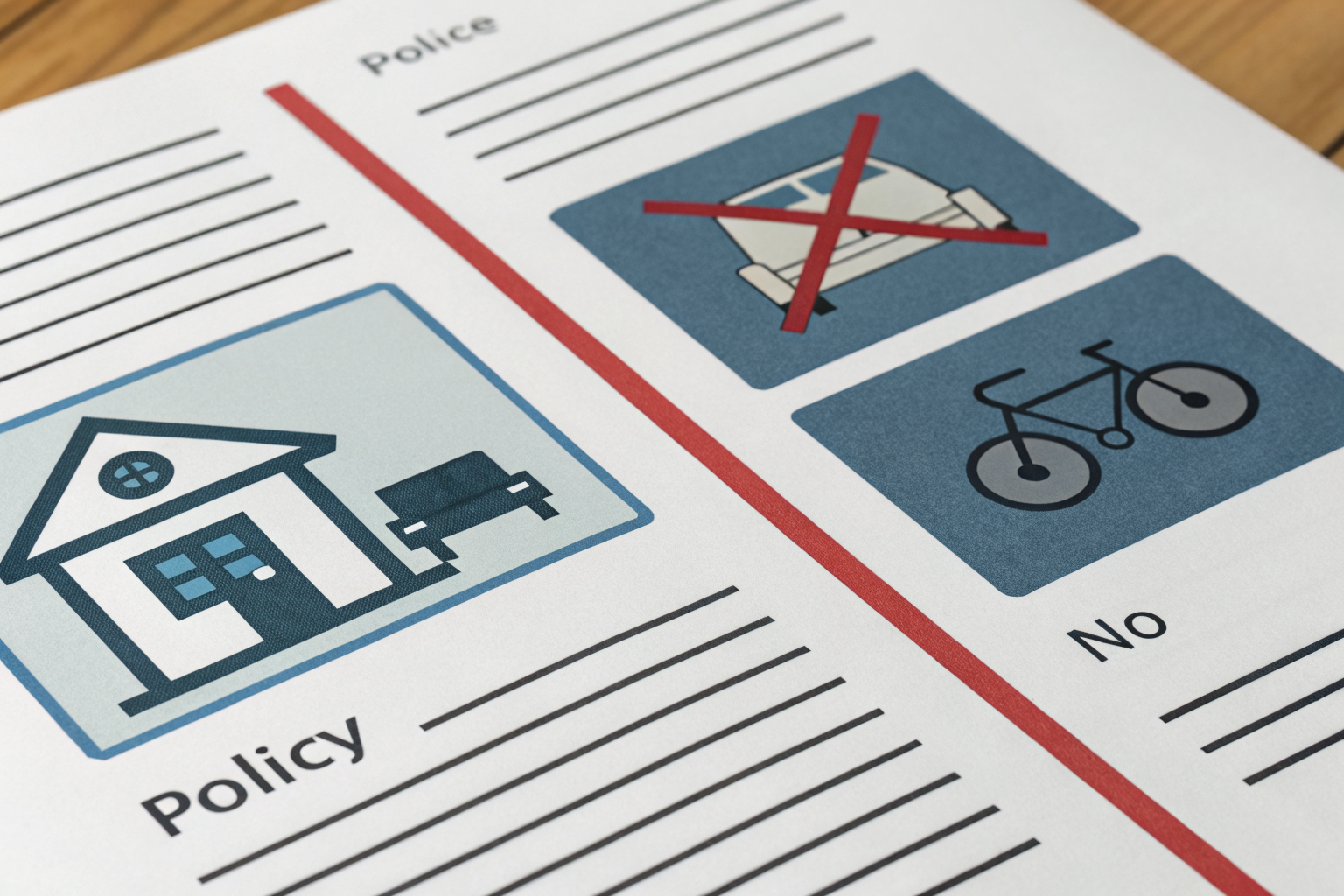
An Arizona HO-3 policy is a named-peril liability / open-peril personal property contract filed with the Arizona Department of Insurance and Financial Institutions. This means the policy covers personal property, your furniture, electronics, bikes, against most physical losses, while liability coverage protects you if someone gets hurt on your property or because of your actions. For most household items, that two-part structure works cleanly. For e-bikes, it creates a fault line.
The fault line is the motorized vehicle exclusion. The HOAIC Arizona HO-3 policy form, DIFI-filed March 2025, contains a standard motorized vehicle exclusion that applies to vehicles designed for use on public roads or with engines or motors above specific thresholds. The exact wording of that threshold determines whether your Class 2 or Class 3 e-bike falls inside or outside coverage. Every carrier that has filed an HO-3 form in Arizona includes some version of this exclusion, though the specific speed cutoffs and motor-wattage thresholds vary.
Arizona HO-3 policies classify e-bikes in a gray zone between a bicycle, which is covered personal property, and a motorized vehicle, which is excluded from liability coverage. This means the same bike can be partially covered for theft and entirely excluded for liability, two separate questions governed by the same exclusion language.
The classification question is the hinge point for every coverage analysis. Before you file a claim or assume you’re covered, you need to know: does your carrier’s filed exclusion language treat your specific bike as a bicycle or a motorized vehicle? That answer changes everything in sections 3 and 4 below.
This article is educational. Consult a licensed Arizona insurance agent for advice specific to your situation and your bike’s class before assuming coverage applies.
The E-Bike Class System, and Why Class 3 Changes Everything

E-bike classification determines whether Arizona homeowners exclusions apply to your bike. The federal three-class system, established under the Consumer Product Safety Act and adopted as a reference standard by most carriers, sorts e-bikes by speed and throttle configuration.
| E-Bike Class | Max Assisted Speed | Throttle | Typical HO-3 Treatment | AZ Liability Risk |
|---|---|---|---|---|
| Class 1 | 20 mph | No throttle (pedal-assist only) | Usually treated as bicycle, personal property covered, liability grey area | Low, most carriers don’t trigger motorized exclusion |
| Class 2 | 20 mph | Throttle-assist available | Usually treated as bicycle, personal property covered, liability grey area | Moderate, throttle presence causes some carriers to flag |
| Class 3 | 28 mph | Pedal-assist only (no throttle) | Often treated as motorized vehicle, exclusion fires for liability | High, 28 mph threshold triggers exclusion in most DIFI-filed forms |
Arizona ARS 28-964 applies helmet requirements to riders under 18 on motorized devices. Class 3 e-bikes fall within the scope of motorized bicycle definitions under AZ statutes, which directly affects how carriers filed their exclusion language with DIFI. To be clear: ARS 28-964 only mandates helmets for riders under 18. The classification discussion here is about policy exclusions, not the helmet rule itself. But the statutory definition carriers pointed to when drafting their exclusion language is the same one ARS 28-964 uses, so the two are connected.
The class label on the bike matters less than the motor and speed threshold in your carrier’s filed policy language. A carrier that sets its motorized exclusion threshold at 25 mph will catch Class 3 bikes. One that sets it at 30 mph might not. Those thresholds vary, and you won’t find them on the declarations page, you’ll find them buried in the exclusions section of the policy form itself.
For a full picture of how Arizona motorcycle insurance requirements apply to higher-powered two-wheelers, see the motorcycle insurance arizona requirements article in this cluster. And if you’re working through the broader question of what Arizona policies cover and exclude, the arizona insurance guide covers the full framework.
Does Homeowners Insurance Cover a Stolen E-Bike in Arizona?

Homeowners personal property coverage pays theft claims for e-bikes subject to sub-limits, deductibles, and motorized exclusion carve-outs. Here’s exactly how that plays out at claim time:
- File the claim. Your carrier’s adjuster confirms the bike qualifies as personal property under your policy, this step usually passes for Class 1 and Class 2 bikes, and sometimes for Class 3 if the carrier hasn’t flagged it yet.
- The adjuster checks the motorized vehicle exclusion. The carrier reviews whether your bike’s class, speed rating, or motor wattage triggers the exclusion language in the filed HO-3 form. If it does, the claim stops here, no payout regardless of the theft.
- If covered, the personal property sub-limit applies. Most standard AZ HO-3 personal property sub-limits for bicycles run $1,500 or less for unscheduled bikes. On a $3,500 Class 3 e-bike, that means the homeowners policy pays out $1,500 minus your deductible, even if coverage isn’t excluded.
- Your deductible reduces the payout further. With a $1,000 deductible, common on Arizona HO-3 policies, a $3,000 e-bike theft claim nets out to $500 after the sub-limit and deductible are applied.
- If denied under the motorized exclusion, the homeowners policy pays nothing. The exclusion is binary. There’s no partial payout, no depreciated value, no negotiation.
The fix for steps 3 and 4 is a scheduled-item rider. Adding your bike by serial number and appraised value to your homeowners policy removes the sub-limit and often drops the deductible to $0 for that item. A scheduled bicycle floater typically adds $25 to $75 per year per $1,000 of bike value on AZ homeowners and renters policies. Closing the theft sub-limit gap on a $4,000 e-bike costs roughly $100 to $300 annually, far less than the coverage shortfall at claim time.
One important distinction: scheduling closes the theft gap. It does not touch the liability gap. Those are two separate problems requiring two separate solutions.
The Liability Gap: Why Theft Coverage and Injury Coverage Are Not the Same Thing

Homeowners liability coverage excludes motorized vehicle injuries, shifting Class 3 e-bike liability to an uncovered gap. Most e-bike owners don’t know this because theft and liability read as one coverage on the declarations page. They’re not.
Coverage E on a standard Arizona HO-3 policy is the personal liability section. It pays when someone is injured because of your actions or on your property. Standard Arizona HO-3 liability limits run $100,000 to $300,000 per occurrence, but that coverage is void for motorized vehicle injuries, meaning a Class 3 e-bike accident with serious bodily injury leaves the rider personally exposed for 100% of the damages if no separate liability policy is in place.
Here’s a concrete scenario. You’re on your Class 3 e-bike, traveling at 26 mph on a shared path. You clip a pedestrian. They break a wrist and miss six weeks of work. Their medical bills come to $22,000. Their lost wages add another $8,000. They retain an attorney. Your homeowners carrier reviews the claim, confirms your bike is classified as a motorized vehicle under the filed exclusion language, and denies the liability claim entirely. You are personally on the hook for the full $30,000 plus your own legal defense costs.
The liability limits structure on a homeowners policy was never designed for motorized-vehicle incidents. That’s what a motorcycle liability policy is for. A motorcycle liability policy is a separate line of coverage, it requires its own application, its own premium, and in some cases requires the e-bike to be registered if classified as a motorized vehicle under AZ statutes. Specialty micromobility endorsements exist too, though availability varies by carrier.
One cross-coverage note worth flagging: if the other party involved in an e-bike accident is an uninsured or underinsured motorist, the exposure compounds. Arizona uninsured motorist property damage coverage rules apply to motor vehicles, not to e-bikes operating under a homeowners policy, so a Class 3 rider also lacks UM/UIM protection from that angle. The gaps stack.
What Actually Covers an E-Bike in Arizona, and How to Fix the Gaps
Arizona e-bike owners close coverage gaps by combining a scheduled-item rider with a motorcycle or specialty liability policy based on bike class. The table below maps each class to its actual coverage status and the correct fix.
| E-Bike Class | HO-3 Theft Coverage | HO-3 Liability Coverage | Fix for Theft Gap | Fix for Liability Gap | AZ Registration Typically Required |
|---|---|---|---|---|---|
| Class 1 (pedal-assist, 20 mph) | Yes, subject to $1,500 sub-limit | Grey area, carrier-dependent | Scheduled-item rider | Specialty endorsement (consult agent) | No |
| Class 2 (throttle, 20 mph) | Yes, subject to $1,500 sub-limit | Grey area, throttle presence may trigger exclusion | Scheduled-item rider | Specialty endorsement (consult agent) | No |
| Class 3 (pedal-assist, 28 mph) | Often excluded or sub-limited | Excluded under motorized vehicle clause | Scheduled-item rider (confirm exclusion doesn’t apply first) | Separate motorcycle or micromobility liability policy | Possibly, check AZ DMV classification |
The decision tree in plain language: Class 1 and 2 owners mostly need a scheduled rider to get full replacement value on theft. The liability question is still carrier-dependent, but the risk is lower because most carriers filing HO-3 forms in Arizona don’t trigger the motorized exclusion below 20 mph. Class 3 owners need both the scheduled rider and a separate liability solution. No endorsement on a homeowners policy fills that liability gap, the carrier has already excluded the vehicle class.
Renters insurance follows the same logic. If you rent your home and own a Class 3 e-bike, your renters policy carries the identical personal property sub-limit and the identical motorized vehicle exclusion. The liability gap is the same. If you’re already struggling to find standard coverage at all, the cant get homeowners insurance arizona situation some AZ riders face when their property profile gets complicated is a reminder that carrier appetite for non-standard risks varies, and shopping matters.
One more consideration worth noting: the flood angle is separate but adjacent. If your e-bike is stored in a garage that floods during a monsoon event, the homeowners personal property coverage question and the flood coverage question are different claims governed by different policy sections. The do i need flood insurance in phoenix analysis applies to the structure and its contents, but that’s a separate article.
The action step before your next renewal: pull your current policy’s motorized vehicle exclusion language, find the speed or motor threshold, and compare it to your bike’s spec sheet. That tells you which column you’re in before a claim tells you.
Frequently Asked Questions
Are e-bikes covered by renters insurance in Arizona?
Renters insurance covers e-bikes under personal property the same way homeowners does, up to the policy’s sub-limit for bicycles, typically $1,500 or less, and only if the motorized vehicle exclusion doesn’t apply to your bike’s class. Class 3 e-bikes face the same exclusion risk on a renters policy as on a homeowners policy. A scheduled rider added to your renters policy closes the theft gap; a separate liability endorsement or specialty policy is still needed for injury coverage.
Does homeowners insurance cover my e-bike if it’s stolen from my car or a bike rack?
Standard Arizona HO-3 personal property coverage follows your belongings off-premises, including a bike stolen from a vehicle or public rack, subject to an off-premises sub-limit that is often 10% of your personal property limit. The motorized vehicle exclusion still applies regardless of where the theft occurred, if your Class 3 e-bike is excluded at home, it’s excluded in a parking garage too. A scheduled-item rider typically extends full replacement coverage both on and off your property.
Do I need a separate policy for my e-bike in Arizona?
Whether you need a separate policy depends on your bike’s class and how your current carrier has filed its motorized vehicle exclusion with the Arizona Department of Insurance and Financial Institutions. Class 1 and 2 owners can often get adequate theft coverage through a scheduled rider on an existing homeowners or renters policy. Class 3 owners should consult a licensed Arizona agent about whether a motorcycle liability endorsement or specialty micromobility policy is needed to cover bodily injury claims, the homeowners liability section will not cover those if the bike is classified as a motorized vehicle.