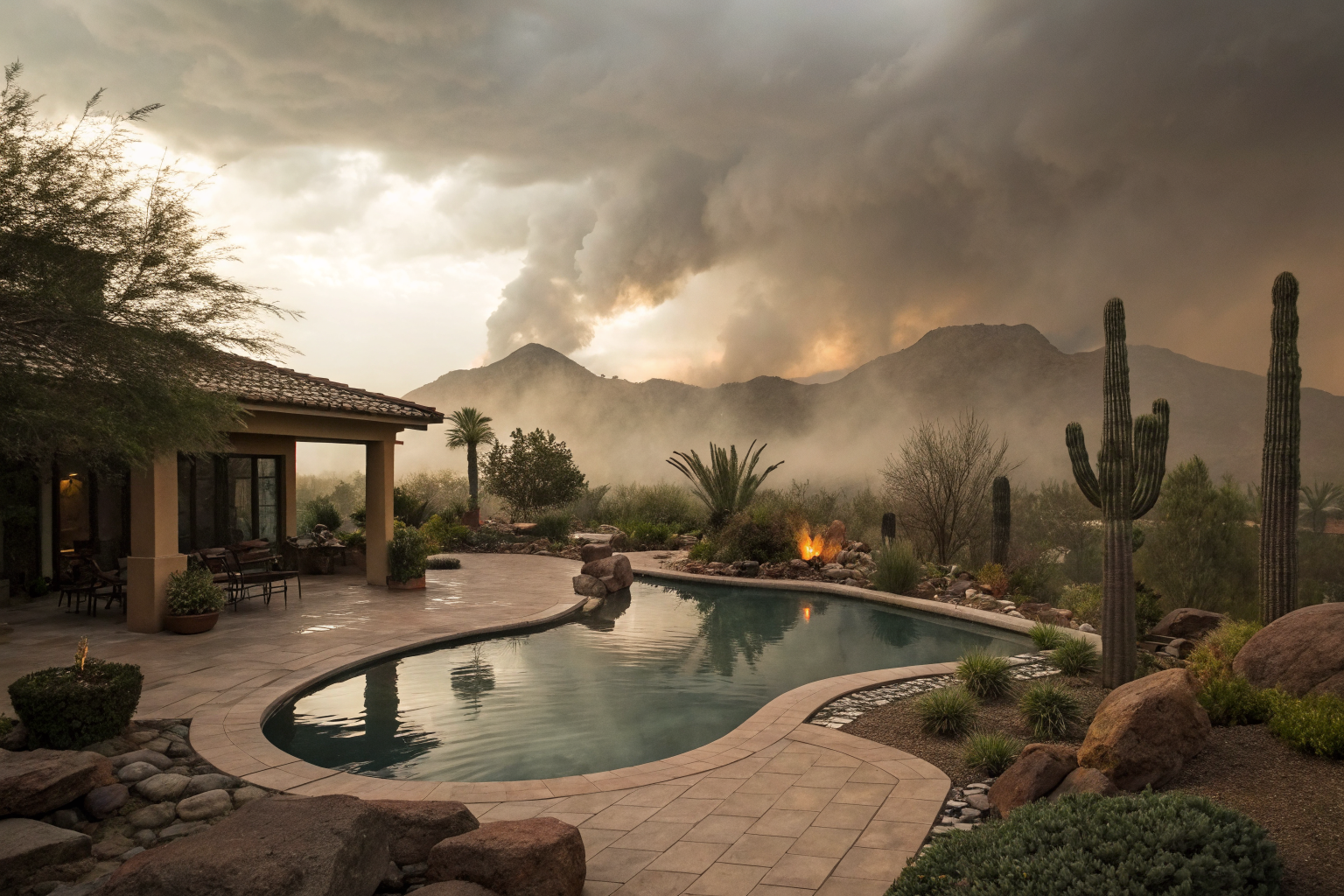
STR pool liability Arizona hosts face is not a single coverage gap, it is a stack of exposures that compounds the moment a paying guest arrives. An Arizona pool turns a short-term rental into a liability problem most hosts do not discover until a guest is in the ER.
Key Takeaways:
- A standard HO-3 policy voids the moment you collect STR revenue, pool liability included, and AirCover does not fill that gap for bodily injury claims above its sub-limits.
- Arizona’s attractive-nuisance doctrine treats an unenclosed pool as an open invitation to uninvited children; one incident without a compliant barrier can expose the host to uncapped personal liability that a $300,000 base policy will not touch.
- A personal umbrella sitting above a voided base policy pays nothing, umbrella sizing for STR pool hosts requires a purpose-built STR liability form as the underlying coverage, with a $1M minimum before the umbrella attaches.
What the Standard HO-3 Policy Actually Does When You Add a Pool and a Paying Guest

The STR pool liability stack is the layered set of exposures, property damage, bodily injury, attractive-nuisance claims, and platform coverage gaps, that activates when a short-term rental property includes a pool. This means no single policy form addresses the full exposure, and hosts who rely on a standard homeowners policy are unprotected the moment rental income enters the picture.
A standard AZ HO-3 policy contains a business-pursuits exclusion. That exclusion voids liability coverage the moment you collect rental income. Pool liability does not survive that exclusion. If a guest slips on wet decking, suffers a spinal injury, and files a claim, the carrier’s first response is to confirm whether the property was being rented at the time. If it was, the claim is denied on business-use grounds, regardless of how long you have held the policy or how much you have paid in premiums.
AirCover is a damage reimbursement program, not a licensed insurance policy. AZ DIFI does not regulate it. Its liability protections carry a $1M per-occurrence sub-limit for host liability, but that figure is misleading: many policy interpretations exclude bodily injury claims arising from pool incidents, and the program’s terms can change without DIFI review. Hosts who treat AirCover as their primary liability coverage for pool injuries are carrying a gap they cannot see until the claim is denied.
Material misrepresentation is the deeper problem. If you collected STR revenue without disclosing that use to your carrier at application or renewal, the carrier can rescind the entire policy, not just the liability portion. Every coverage, including your dwelling coverage, disappears. ARS 9-500.39, the STR preemption statute that allows short-term rental operation across Arizona municipalities, makes this worse for hosts who assumed a local ban would limit their exposure. The preemption statute removed that excuse. STR operation is legal across AZ, which means every host is expected to carry proper coverage for it. A full overview of what an airbnb insurance arizona policy needs to do is covered in the pillar on that topic; this article focuses on what changes when a pool is part of the property. For the broader framework on how Arizona coverage works across property types, the arizona insurance guide covers the foundational mechanics.
The Attractive-Nuisance Problem: Why an Arizona Pool Multiplies Your Exposure as an STR Host
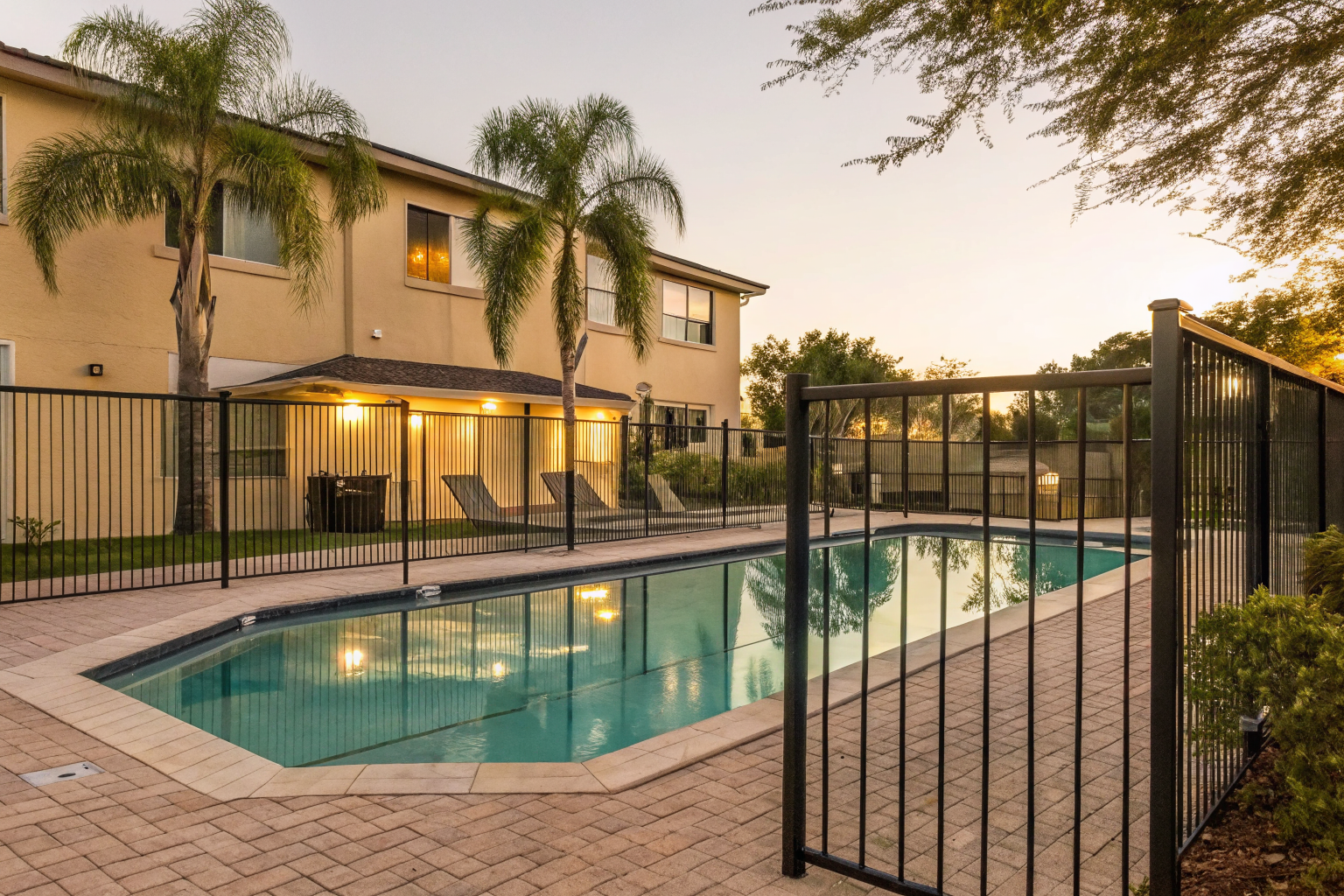
Pool attractive-nuisance exposure extends liability to uninvited third parties, not just paying guests. That distinction matters more for STR hosts than for residential homeowners, because STR operation increases the number of people passing through the property and the likelihood that a gate gets left unlatched.
Arizona’s attractive-nuisance doctrine holds that a property owner who maintains a condition that foreseeably attracts children who cannot appreciate the risk bears a duty of care toward those children, even if they are trespassers. A pool is the clearest example courts recognize. A neighbor’s five-year-old who wanders through an unlocked gate creates the same liability exposure as a paying guest. The host’s liability does not stop at the rental agreement.
The city ordinance overlay sharpens this exposure. Phoenix requires a minimum 5-foot perimeter fence with a self-latching gate for any residential pool. Scottsdale, Chandler, Mesa, and Gilbert enforce similar barrier requirements, including door alarms for any home entry that provides direct pool access. These are not suggestions. A non-compliant barrier at the time of a pool incident is evidence of negligence per se under Arizona tort law. Negligence per se means the plaintiff does not have to prove the host acted unreasonably, the code violation establishes it. That removes the carrier’s ability to argue comparative fault and gives the plaintiff a stronger civil case from the first filing.
STR operation raises the baseline pool exposure in a specific way: guest volume. A property with 30 or more guest-nights per year has a higher probability of a gate being left open, a child being unsupervised near the water, or a guest unfamiliar with pool depth misjudging a dive. Each guest turnover is another opportunity for a safety gap to open. Hosts who want to understand how phoenix metro STR rules interact with property safety requirements will find that local permitting and pool compliance are treated as linked obligations by most AZ municipalities, not separate tracks.
The thing that catches people off guard: pool barrier compliance is not a one-time check. If you make any modification to the pool area, fence, or gate between inspections, local code may require re-verification. A gate latch that corrodes and fails to self-close is a code violation even if it was compliant at installation.
STR Pool Liability Coverage Options: What Each Layer Actually Does

The liability limits structure determines whether an umbrella policy attaches after a pool injury claim. If the base layer has been voided by non-disclosure or a business-use exclusion, the umbrella carrier can deny the claim on the grounds that required underlying coverage was not in force. Building the stack correctly means understanding what each layer does and what it requires beneath it.
| Coverage Layer | What It Pays | Pool Injury Covered? | Underlying Requirement | Typical AZ Limit Range |
|---|---|---|---|---|
| STR-specific dwelling policy or DP-3 with STR endorsement | Property damage to the structure and liability for bodily injury during rental periods | Yes, when the form includes STR liability and pool use is disclosed | None, this is the base layer | $300,000–$500,000 liability |
| Commercial general liability or specialty STR liability rider | Bodily injury and property damage arising from business use of the property | Yes, this layer is specifically designed to survive business-use scenarios | Active base property policy | $500,000–$1M per occurrence |
| Host platform coverage (AirCover / VRBO host guarantee) | Guest property damage reimbursement and limited host liability | Excluded or sub-limited in many pool injury interpretations; not DIFI-regulated | None, but does not replace licensed insurance | Up to $1M per occurrence (terms subject to change) |
| Personal or commercial umbrella | Excess liability above all underlying layers | Yes, but only if all underlying policies are valid and in force at the time of the incident | Valid STR base policy with at least $300,000 underlying liability | $1M–$5M |
A $1M personal umbrella in Arizona requires $300,000 underlying liability on the base homeowners or STR policy. If that base layer is voided, because the host never disclosed STR use, or because the standard HO-3 excluded business-use claims, the umbrella carrier denies the claim. The underlying coverage was not in force, so the umbrella has no valid base to sit above.
Host platform coverage fills a specific, narrow role: it reimburses documented damage between guests and provides a limited liability backstop for claims the platform chooses to accept. It is not a substitute for the base layer or the umbrella. Treating AirCover as a coverage layer in the liability stack is the most common structural mistake STR pool hosts make.
Hosts who carry proper STR coverage for other reasons, perhaps because they sought out an insurance agency scottsdale az referral after a coverage question arose, are often surprised to learn that pool disclosure is a separate step. The STR endorsement that covers short-term rental use does not automatically extend to pool liability unless the pool is listed and the carrier has confirmed it is rated into the premium.
How Do You Size the Umbrella for an Arizona STR With a Pool?

Umbrella sizing depends on asset exposure plus the pool-specific bodily injury risk that comes with STR use. A drowning death in a residential pool can produce wrongful-death settlements in the $1M–$3M range in Arizona civil courts. A $300,000 base policy with a $1M umbrella still leaves a gap for hosts with significant assets. The sizing steps below give you a floor, not a ceiling.
Establish what you own. Add net worth plus a reasonable estimate of future income, that total sets the floor for how much liability exposure you cannot afford to absorb. A round number like “$1M should be enough” is not sizing logic; it is a guess.
Identify the pool risk multiplier for your specific property. An STR pool in a Phoenix suburb hosting 30 or more guest-nights per year has materially higher exposure than a residential pool used twice a week by the same family. More guest turnover means more gate-latching failures, more unfamiliar swimmers, and more incidents.
Confirm the underlying STR liability policy survives business use before doing any umbrella math. If the base layer voids on rental income, the umbrella calculation is irrelevant, you have no stack to size above.
Size the umbrella at a minimum of $1M per occurrence above the base layer. Hosts with significant assets or high guest volume should start at $2M and work upward from there. The umbrella premium difference between $1M and $2M is typically small relative to the exposure gap it closes.
Disclose the STR use to your umbrella carrier at application. Non-disclosure here is the same material misrepresentation problem that voids the base policy. An umbrella carrier who learns of undisclosed STR use at the time of a pool injury claim has grounds to deny coverage on the same basis as the base carrier.
Hosts who have already reviewed their motorcycle insurance arizona coverage know this principle from a different angle: every policy layer requires accurate disclosure of how the asset is used. The umbrella is no different.
What the ARS 9-500.39 Preemption and Local STR Ordinances Actually Add to Your Liability Exposure
ARS 9-500.39 STR preemption prevents municipalities from banning STR operation outright, but it does not override local pool safety ordinances. These are two separate bodies of law operating on different tracks, and confusing them is a coverage mistake.
The 2022 amendment to ARS 9-500.39 clarified that cities can regulate STR safety and licensing, they just cannot impose an outright ban. Phoenix, Scottsdale, and Mesa can require STR permits, impose inspection requirements, and enforce pool barrier compliance on rental properties. A Scottsdale STR host cannot argue that the preemption statute overrides the city’s pool fence code. The preemption removes the ban; it does not remove the safety obligation. Failing a pool safety inspection while operating an STR creates both a regulatory violation and an insurance-disclosure problem, because the carrier will ask whether the property was compliant at the time of any incident.
ARS 20-1510 introduces a compounded liability exposure that many STR hosts with pools have not considered. Arizona carriers use ARS 20-1510 as authority to ask about dog breed and bite history during underwriting. A dog at an STR property with a pool creates two overlapping exposures: a guest bitten near the pool, or a dog that causes a guest to fall into the water. Non-disclosure of a dog, especially a restricted breed, is material misrepresentation under the same standard that voids the base policy for undisclosed STR use. Both failures lead to the same outcome: the carrier rescinds coverage at the moment the claim arrives.
Hosts who rent seasonally and then leave the property vacant need to check the vacancy clause in their STR policy. Standard vacancy clauses void coverage after 30 to 60 days of unoccupied status. An STR host who rents through March and then leaves as a snowbird through October may have a coverage gap across the vacancy period unless the policy explicitly addresses it. That gap includes pool liability for any trespasser incident during the off-season. Hosts across the Phoenix metro looking for agents who handle this intersection of STR, pool, and vacancy issues will find that arizona insurance agency locations serving the East Valley are familiar with the snowbird-STR overlap as a distinct coverage question.
Frequently Asked Questions
Does Airbnb insurance cover a pool injury at my Arizona rental?
AirCover is a host damage reimbursement program, not a licensed insurance policy, AZ DIFI does not regulate it, and its liability protections carry sub-limits and exclusions that may not respond to a pool drowning or serious bodily injury claim. A purpose-built STR liability policy or DP-3 with STR endorsement is the only coverage layer that pays pool-related bodily injury claims with any reliability. Without that base layer in force, your personal umbrella cannot attach.
What pool safety requirements does Arizona law require for short-term rentals?
ARS 9-500.39 prevents cities from banning STR operation but does not override local pool safety codes, Phoenix, Scottsdale, Mesa, Chandler, and Gilbert all enforce pool barrier requirements including minimum fence heights and self-latching gates that apply to STR properties. Failure to comply with local barrier codes at the time of a pool incident can establish negligence per se in Arizona civil litigation. Confirm compliance with your specific municipality’s pool ordinance before listing the property.
Does my regular homeowners insurance cover pool liability for short-term rental guests?
No. The standard AZ HO-3 contains a business-pursuits exclusion that voids liability coverage the moment you collect rental income, pool liability does not survive that exclusion. Collecting even one night’s STR revenue without a purpose-built STR policy means a pool injury claim will be denied on business-use grounds, and failing to disclose the STR use at application is material misrepresentation that gives the carrier grounds to rescind the entire policy.