Arizona motorcycle helmet law works differently than most riders assume. Most AZ riders know they can skip the helmet, what they don’t know is what that choice does to their insurance claim when they go down. As of 2025, ARS 28-964 is narrower than most people expect, and the insurance consequences of riding adult-optional are real.
Key Takeaways:
- ARS 28-964 requires a helmet for riders and passengers under 18 only, adults have no statutory obligation, but the choice follows you into your claim file.
- Riding without a helmet as an adult is legal in Arizona, but most AZ carriers treat it as a contributory-negligence factor that can reduce or complicate a bodily-injury or UM/UIM payout.
- Arizona rides year-round, 12 months of road exposure means the helmet decision isn’t seasonal; it’s a standing risk calculation that affects both safety and liability outcomes every ride.
This article is part of the broader arizona insurance guide for Arizona riders and homeowners. Whether you’re working through a motorcycle insurance checklist for Arizona or trying to understand the e-bike insurance gap in Arizona, the helmet question sits at the center of how your claim gets handled after a crash.
What Does Arizona’s Motorcycle Helmet Law Actually Say?
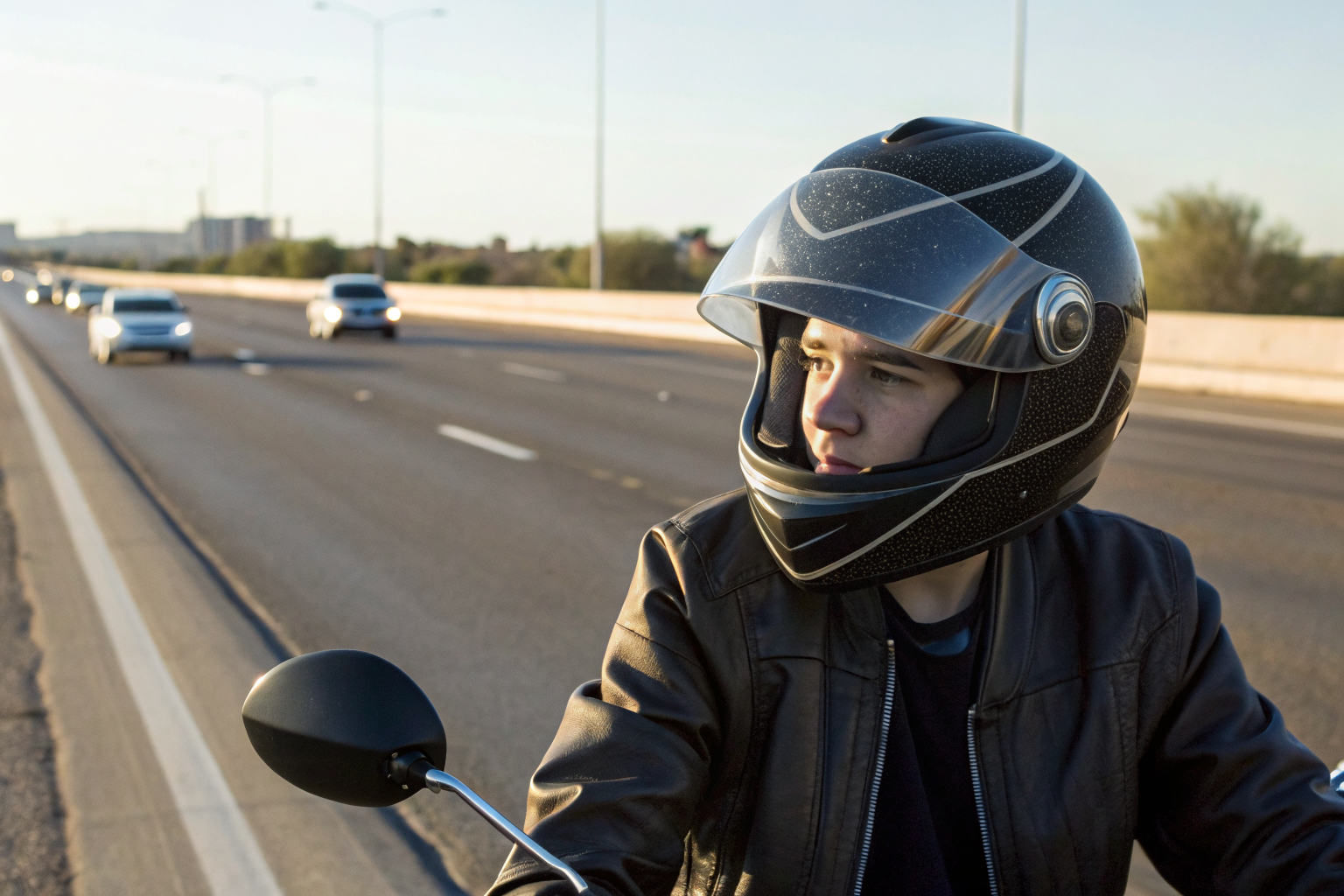
ARS 28-964 is the specific provision within the Arizona Revised Statutes that governs motorcycle helmet use. It requires any person under the age of 18 who operates or rides as a passenger on a motorcycle to wear a protective helmet that meets FMVSS 218, the federal motor vehicle safety standard for motorcycle helmets administered by NHTSA. This means the legal obligation is age-based and narrow, it covers minors operating motorcycles and minors riding as passengers, full stop.
Adults 18 and over have no helmet requirement under Arizona law. That is the statute as written, and no city or county ordinance in Arizona can add to it.
What ARS 28-964 does not say matters just as much as what it does. The statute does not specify helmet style beyond the FMVSS 218 federal standard, a compliant helmet can be full-face, open-face, or half-shell, as long as it meets the federal certification. The statute does not require eye protection by statute, though the Arizona Department of Transportation recommends it for safety. The statute also does not apply to enclosed three-wheel vehicles that Arizona motor vehicle law classifies differently from motorcycles.
The most common misread of this statute involves passengers. Parents who ride with minor children, and adult operators who carry teenage passengers, often assume the helmet rule only applies to young operators. ARS 28-964 applies to passengers as well as operators. An adult riding with a 16-year-old on the back is legally responsible for that passenger wearing an FMVSS 218-compliant helmet. The violation exposure belongs to the operator.
FMVSS 218 is a federal standard set by NHTSA, the National Highway Traffic Safety Administration. A novelty helmet or hard hat does not satisfy it. NHTSA maintains a public database of certified helmets. A minor wearing a non-compliant helmet is treated the same as a minor wearing no helmet under the statute.
For situations specific to your policy or any enforcement question, consult a licensed Arizona attorney or a licensed insurance agent, statute interpretation and claim outcomes depend on facts that vary by situation.
Who Must Wear a Helmet in Arizona, Riders, Passengers, and the Age Cutoff

ARS 28-964 draws one bright line: age 18. Everything else follows from that. The table below maps the four common rider scenarios to what the statute requires, what a violation looks like, and who the legal exposure falls on.
| Scenario | Helmet Required Under ARS 28-964? | Who Faces Violation Exposure? | Notes |
|---|---|---|---|
| Operator under 18 | Yes, FMVSS 218-compliant helmet required | The minor operator (and potentially a supervising adult) | Applies regardless of passenger status |
| Operator 18 or older | No statutory requirement | No violation for helmet choice | Adult-optional rule is absolute under AZ state law |
| Passenger under 18, operator any age | Yes, FMVSS 218-compliant helmet required for the passenger | The operator, not the passenger | This is where adult riders most often get caught |
| Passenger 18 or older, operator any age | No statutory requirement | No violation for helmet choice | Adult passengers are fully optional under the statute |
Minor passengers require a helmet under ARS 28-964 regardless of whether the operator is also a minor. A 17-year-old operator carrying a 15-year-old passenger needs both parties helmeted. A 30-year-old operator carrying a 17-year-old passenger needs the passenger helmeted. The operator’s age does not change the passenger’s obligation.
One detail that surprises many Arizona riders: the adult-optional rule under Arizona state law is not subject to local override. Unlike some states where municipalities have enacted stricter helmet ordinances for adult riders, Arizona’s preemption framework prevents cities and counties from adding requirements beyond what state statute mandates. Scottsdale cannot require helmets where the state does not. Neither can Phoenix, Mesa, or any other jurisdiction.
Compliance requires an FMVSS 218-compliant helmet, not just any head covering. NHTSA certifies compliant helmets and maintains a searchable public database at nhtsa.gov. A minor wearing a non-DOT-certified helmet does not satisfy ARS 28-964, regardless of how protective the helmet appears. The practical implication for adult operators carrying minor passengers: verify that the helmet you hand your passenger carries a DOT certification sticker, which signals FMVSS 218 compliance.
For advice specific to your policy or a specific enforcement situation, speak with a licensed Arizona attorney.
Riding Without a Helmet Is Legal, Here Is What It Costs You Anyway

The legal right to ride helmet-free as an adult in Arizona is not in dispute. The insurance consequences are where riders get surprised.
Arizona follows a pure comparative fault system for civil liability. Under the framework established through ARS Title 12 and Arizona tort law, a jury or adjuster can assign a percentage of fault to any party involved in an accident, including the injured rider. A rider who chose not to wear a helmet, exercising a legal right, can still have their bodily injury recovery reduced by whatever percentage of fault the fact-finder attributes to that choice. The recovery is not eliminated, but it is reduced. A rider found 20% at fault for not wearing a helmet on a $200,000 head-injury claim walks away with $160,000.
This plays out in three specific claim contexts, and understanding all three matters before you decide whether the helmet comes with you.
The first context is a third-party bodily injury claim against an at-fault driver. When an insured driver causes a crash that injures a helmetless rider, the defense attorney’s job includes raising the helmet issue to reduce the damages the carrier owes. Medical evidence connecting head injuries to the absence of a helmet becomes a negotiating point in settlement discussions and a jury argument at trial. The rider’s legal right to ride without a helmet does not make the argument go away.
The second context is a UM/UIM claim on the rider’s own policy. Per ARS 20-259.01, Arizona carriers must offer uninsured and underinsured motorist coverage. When a rider’s own carrier is paying out a UM/UIM claim after an uninsured driver causes a crash, the carrier’s counsel may raise comparative fault in arbitration. The same helmet argument that a defense attorney raises in a third-party claim can surface in the rider’s own policy arbitration. Liability limits structure matters here: a rider who rejected UM/UIM coverage or selected minimum limits is doubly exposed.
The third context is MedPay. MedPay is medical payments coverage that pays without fault attribution, it covers medical bills regardless of who caused the crash. That makes it less affected by the helmet choice than bodily injury or UM/UIM claims. But MedPay limits on motorcycle policies typically run $2,500 to $5,000. Emergency treatment for a head injury without a helmet exhausts that limit fast. The fault-free nature of MedPay helps, but the limit does not stretch far when the injury is serious.
Year-round AZ riding exposure compounds all three of these risks. A rider in Minnesota faces six months of riding season. An Arizona rider faces 12 months of road use, which means 12 months of continuous exposure to the claim scenarios above. The helmet decision is not a seasonal choice here, it is a permanent standing decision with insurance consequences every ride.
For any active claim involving these issues, consult a licensed Arizona attorney. For coverage questions about your specific policy, speak with a licensed agent before adjusting limits or making coverage decisions.
ARS 28-964 and the E-Bike Coverage Gap: Where the Statute Stops

ARS 28-964 applies to motorcycles as defined under Arizona motor vehicle law. E-bikes classified as electric bicycles under ARS 28-101 are not motorcycles, and ARS 28-964 does not apply to them. That distinction creates a legal and coverage gap that catches Phoenix-metro riders off guard, especially those who commute year-round on Class 2 or Class 3 e-bikes.
ARS 28-101 defines an electric bicycle as a distinct vehicle class from a motor vehicle or motorcycle. That classification is the dividing line that determines which regulatory requirements, including ARS 28-964, apply to the rider.
Here is what that gap means in practice:
- Arizona does not require helmets for e-bike riders of any age under current ARS. No Arizona statute mandates helmet use for adult or minor e-bike riders. The under-18 rule in ARS 28-964 only applies to motorcycle riders and passengers, not to electric bicycle riders. This surprises parents who assume the logic carries over.
- E-bike riders are not required to carry motorcycle insurance. A standard auto policy or homeowners liability section may be the only coverage in place after a crash involving an e-bike. That coverage was not written with road crashes in mind, and exclusions apply. A rider who assumes they are covered because they have auto insurance may find otherwise.
- The comparative fault logic from the previous section still applies in civil court regardless of whether a helmet was required. A helmetless e-bike rider who suffers a head injury in a crash can still have their civil recovery reduced under Arizona’s pure comparative fault framework. The absence of a legal helmet requirement does not remove the fault argument from the courtroom.
- Year-round AZ riding exposure applies to e-bikes the same as motorcycles. Arizona’s 12-month riding calendar means 12 months of uninsured-gap risk for e-bike riders who have not confirmed their coverage. A crash in January carries the same coverage gap as a crash in July.
- Standalone e-bike insurance products exist as endorsements or specialty policies. If you ride an e-bike in Arizona and your coverage question is whether you are protected after a crash, ask your agent about e-bike insurance in Arizona, the answer is not in your auto declarations page.
The e-bike coverage gap is a separate topic from ARS 28-964, but the two questions arrive together when a Phoenix-metro commuter asks whether they need a helmet and whether they are covered. The statute answers the first question narrowly. The second question requires a policy review.
What the Helmet Decision Means for Your Motorcycle Insurance in Arizona

Helmet use documentation affects how claims get negotiated on Arizona motorcycle bodily injury and UM/UIM claims. Knowing that before you ride changes what you do with your coverage.
These steps apply to Arizona motorcycle riders who want their policy to reflect the actual exposure they carry:
- Review your current bodily injury and UM/UIM limits before your next ride. Per ARS 20-259.01, Arizona carriers must offer UM/UIM coverage at limits matching your bodily injury liability limits unless you reject in writing, meaning your UM/UIM limits are a direct reflection of how much protection you chose. Low limits combined with a helmet-free riding habit creates compounding exposure on the recovery side.
- Confirm your MedPay limit on your motorcycle policy. Typical limits of $2,500 to $5,000 pay without fault attribution but exhaust fast on emergency head-injury treatment. If you ride without a helmet, this is the coverage that functions without a comparative fault argument attached.
- If you carry a passenger, confirm whether the passenger is under 18 before every ride. ARS 28-964 makes the operator legally responsible for a minor passenger’s helmet compliance. An unhelmed minor passenger creates operator fault exposure and a potential policy complication if a claim follows.
- Document your riding gear choices as a matter of habit. Carriers and defense attorneys review accident scene photos and witness statements. A documented pattern of wearing protective gear can support your claim position; the absence of a helmet in those photos becomes a data point in comparative fault arguments.
- Ask your agent whether your motorcycle policy includes any helmet-use exclusions or gear-compliance conditions. Some specialty motorcycle policies include language about protective equipment and claim cooperation. Knowing what your policy says before a crash is better than finding out after.
- For year-round AZ riders, treat these steps as a continuous review, not a one-time check. Twelve months of riding means the exposure is standing, not seasonal. A coverage review in March that you skip in October still leaves a gap.
These are general considerations based on how Arizona insurance and tort law interact. They are not legal or coverage advice specific to any individual policy. Consult a licensed Arizona agent to review your specific declarations page, and consult a licensed Arizona attorney for any active claim or enforcement situation. A motorcycle insurance checklist for Arizona riders is a practical next step for confirming your current coverage against the exposure you actually carry.
Frequently Asked Questions
Does Arizona require a motorcycle helmet?
Arizona does not require a helmet for riders or passengers age 18 and older. Under ARS 28-964, only riders and passengers under 18 must wear a helmet meeting FMVSS 218 federal safety standards. Adults who ride without a helmet are not violating state law, but that choice can reduce bodily injury claim payouts under Arizona’s pure comparative fault system.
Is a helmet required in Arizona for motorcycle passengers?
Yes, if the passenger is under 18. ARS 28-964 applies to passengers as well as operators, an adult rider carrying a minor passenger who is not wearing an FMVSS 218-compliant helmet is in violation of the statute. The legal exposure falls on the operator, not the passenger. Adult passengers 18 and over face no statutory helmet requirement.
What is the fine for violating Arizona’s motorcycle helmet law?
Arizona treats ARS 28-964 violations as civil traffic violations, with the specific fine amount set by the court and subject to variation. For most adult riders, the fine is not the primary financial concern, the comparative fault reduction that can apply to bodily injury or UM/UIM claim payouts when a helmetless rider is injured is the more significant consequence. Consult a licensed Arizona attorney for advice on any specific enforcement situation.