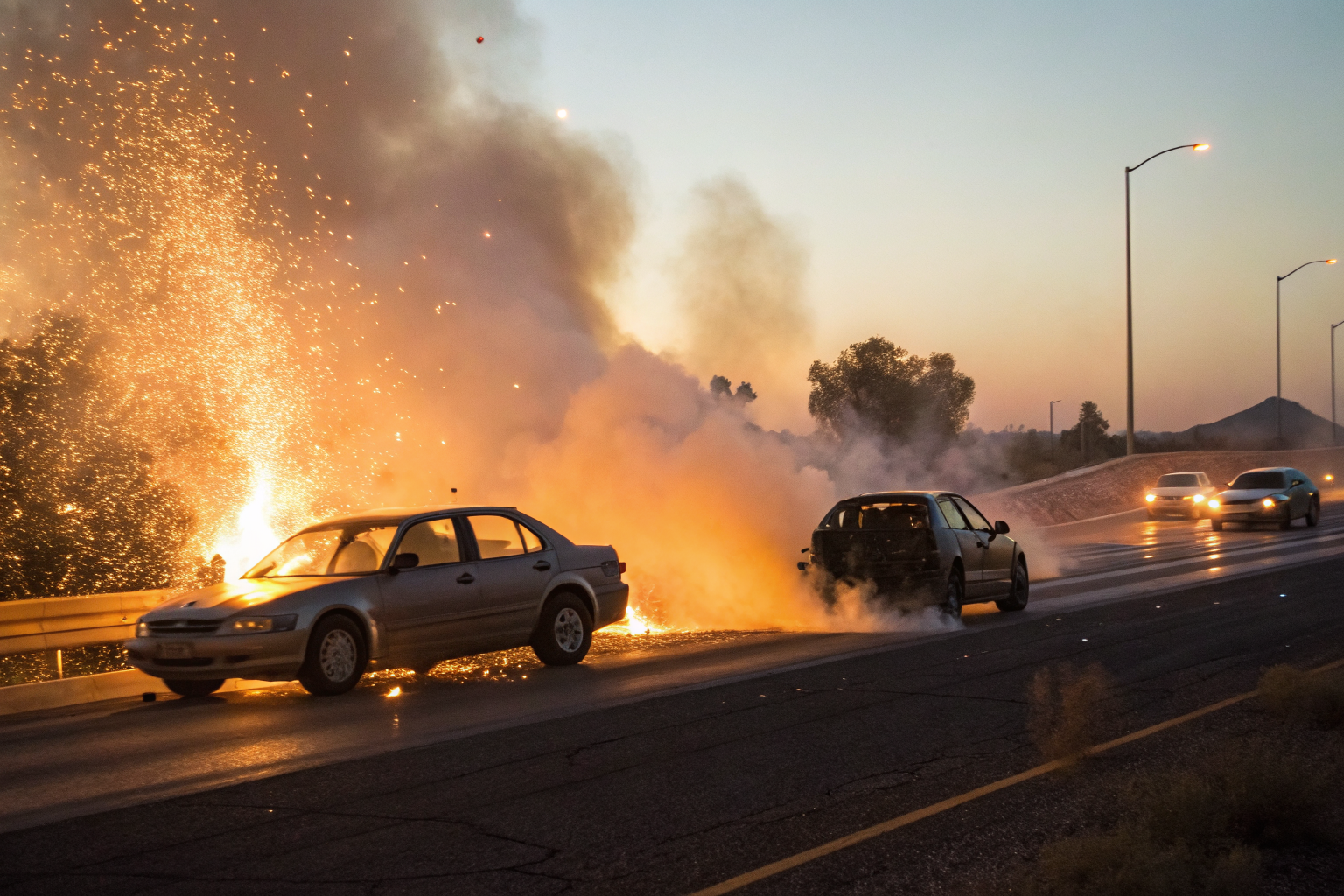
Collision vs comprehensive insurance Arizona drivers carry is not one decision, it’s two. Most Arizona drivers think they have ‘full coverage’ until they file a claim and find out collision and comprehensive are separate choices, each with its own trigger, its own payout mechanic, and its own point where keeping it stops making financial sense. Understanding both is part of any sound arizona insurance guide for desert driving.
Key Takeaways:
- Collision covers contact events, you hit something or something hits you while moving; comprehensive covers everything else, including the hail, flooding, and theft that Arizona’s climate and metro profile make unusually common.
- Arizona lenders require both collision and comprehensive on any financed vehicle; once the car is paid off, the 10% rule gives you a concrete threshold, if your annual premium for a coverage exceeds 10% of the vehicle’s ACV payout, dropping it often makes actuarial sense.
- Neither collision nor comprehensive pays a single dollar toward the other driver’s damages or injuries, that’s what liability limits under ARS 28-4009 handle, and Arizona’s 25/50/15 minimums leave a gap most drivers don’t discover until after the crash.
Collision vs. Comprehensive: What Each Coverage Actually Triggers

Collision coverage is the portion of your auto policy that pays for physical damage to your vehicle caused by contact between a moving vehicle and another object, vehicle, or surface. The trigger is contact while in motion. You rear-end someone on the 202. You clip a median barrier on the I-10. A driver rolls through a stop sign and strikes your car as you move through an intersection. All collision claims. Comprehensive coverage is the portion that pays for physical damage from events that are not collisions, events where nothing you were driving made contact with something else. A haboob drives debris through your windshield. A monsoon flash flood reaches your floorboards in a parking garage. A coyote crosses the I-10 at 11 p.m. and you hit it. Your car disappears from a Scottsdale parking lot. All comprehensive claims.
The term ‘full coverage’ has no legal definition in Arizona. It appears in no filed auto policy form and carries no consistent meaning across carriers. When a driver says they have ‘full coverage,’ they typically mean they carry liability plus collision plus comprehensive, but a policy marketed that way may still exclude specific events, carry gap-creating deductibles, or omit UM/UIM coverage. Coverage triggers vary by policy language; consult a licensed Arizona producer for guidance specific to your vehicle and situation.
Arizona ranked among the top states for vehicle theft rates, per National Insurance Crime Bureau reporting. Comprehensive coverage is the only coverage that pays a theft claim, collision does not.
| Event | Which Coverage Pays |
|---|---|
| You rear-end another car on the 202 | Collision |
| A haboob blows debris into your windshield | Comprehensive |
| Monsoon flash flood water enters your vehicle | Comprehensive |
| You hit a coyote crossing the I-10 at night | Comprehensive |
| Your car is stolen from a Scottsdale parking lot | Comprehensive |
| You strike a median barrier avoiding road debris | Collision |
| A moving vehicle hits your parked car | Collision |
| Hail damages your hood and roof | Comprehensive |
| You roll your vehicle on a desert highway | Collision |
| Falling saguaro branch lands on your roof | Comprehensive |
Do You Need Both Collision and Comprehensive in Arizona?
The answer depends on whether your vehicle is financed. Arizona lenders require both collision and comprehensive on any financed vehicle as a condition of the loan agreement, this is a contract obligation, not a matter of personal preference. Driving a financed car without both coverages exposes you to forced-placed insurance, which your lender purchases on your behalf at rates well above market and with no protection for your interests.
ARS 28-4009 sets Arizona’s minimum financial responsibility requirements at 25/50/15, $25,000 per person bodily injury, $50,000 per occurrence, $15,000 property damage. Per Arizona Department of Transportation financial responsibility requirements, these are the only coverages the state mandates. Neither collision nor comprehensive is legally required for a vehicle you own outright.
Here’s how that plays out across three common situations:
- Financed vehicle: You need both. The lender contract requires it, and the penalty for non-compliance is forced-placed insurance at punishing rates. This is not a financial decision, it’s a contractual one.
- Paid-off vehicle, high ACV: You probably need both. If your vehicle is worth $18,000 or more, the cost of replacing it without coverage exceeds what most households can absorb out of pocket. The 10% rule in Section 4 gives you a specific threshold to evaluate.
- Paid-off vehicle, low ACV: You may be able to drop collision. If your vehicle’s actual cash value is below $8,000 and your annual collision premium clears the 10% threshold, the math works against keeping it. Comprehensive is a separate question, on an Arizona vehicle, the risk profile for theft, hail, and monsoon flooding makes comprehensive harder to argue against even on an older car.
- Neither coverage on a paid-off vehicle: Defensible only if you can absorb a total loss without hardship and the vehicle’s ACV is low. You remain fully exposed to collision and theft events. The liability layer under ARS 28-4009 does not change regardless of what you decide about physical damage coverage.
Note that $15,000 in property damage liability, Arizona’s minimum under ARS 28-4009, does not cover a new vehicle replacement. The average new vehicle transaction price in the U.S. exceeded $48,000 in recent model years, per industry reporting. A single at-fault crash into a newer car can exceed the minimum limit and leave you personally responsible for the remainder.
How the ACV Payout Mechanic Works, and Why It Hits Older Vehicles Hard

ACV is the depreciated market value of your vehicle at the time of loss, not the purchase price, not the loan payoff balance, and not the cost to buy the same car today. This means the payout on a total-loss claim reflects what your vehicle was worth the moment before the event, and in a depreciation curve, that number drops every year.
On a 2019 vehicle worth $9,000 ACV, a total-loss collision claim pays $9,000 minus your deductible. If you owe $12,000 on the loan, the $3,000 gap is yours to cover unless you carry GAP coverage. Your carrier’s ACV calculation uses NADA guides or comparable sales in the Phoenix metro market, not what you paid, not what you feel the car is worth. A five-year-old sedan with 80,000 miles totaled on the 101 gets valued against what a comparable car actually sold for recently in your geographic market.
Depreciation in Arizona compounds faster than national averages on several fronts. Year-round driving means higher annual mileage accumulation. Sustained heat accelerates interior and mechanical component wear. Per automotive industry research, vehicles in hot climates show faster deterioration of interior materials, rubber components, and certain mechanical systems than vehicles driven in moderate climates. An Arizona vehicle with 90,000 miles may carry a lower ACV than a comparable vehicle in a cooler market with the same odometer reading.
This matters for the 10% rule covered in the next section. An ACV that starts at $14,000 and drops $1,500 a year moves through the threshold faster in Arizona than the national average suggests. ACV methodology follows standard actuarial practice and is disclosed in your policy’s definitions section, review yours or ask your producer.
This payout mechanic is also relevant if you’re thinking through the arizona car insurance claim payout process before a loss happens rather than after.
When Should You Drop Collision Coverage on a Paid-Off Arizona Vehicle?
The 10% rule gives Arizona drivers a concrete threshold for deciding when collision premium exceeds expected payout value. Work through it in order:
- Get your vehicle’s current ACV. Use NADA Guides or Kelley Blue Book for the private-party sale value in the Phoenix metro market, not trade-in value, which runs lower. Private-party reflects what you could actually get for the car.
- Pull your current annual collision premium. This number is on your declarations page, listed separately from comprehensive. If you see a combined ‘physical damage’ line, call your producer and ask for the split.
- Apply the 10% threshold. Divide your annual collision premium by the vehicle’s ACV. If the result exceeds 10%, the expected value math starts working against you. Example: a vehicle worth $8,000 ACV with a $900 annual collision premium is at 11.25%, above the threshold.
- Factor in your deductible. A $1,000 deductible on an $8,000 vehicle means the maximum net payout is $7,000 on a total loss. On a $4,000 repair, you net $3,000. The deductible narrows the gap between premium cost and realistic recovery.
- Assess your self-insurance capacity. Can you replace the vehicle without hardship, or absorb a $5,000 repair bill, if you drop the coverage and a loss occurs? If the answer is no, keep the coverage regardless of what the math says. The rule is a guide, not a mandate.
The 10% rule is a personal finance benchmark for evaluating physical damage coverage retention, not a statutory requirement, but a defensible starting point for the decision.
One important distinction: this framework applies to collision specifically. Comprehensive on an Arizona vehicle covers theft, hail, flash flood damage, and animal strikes, events that are disproportionately common in the Phoenix metro relative to the national average. Comprehensive premiums are typically lower than collision premiums, which shifts the 10% calculation considerably. Dropping comprehensive is a separate decision and often a less defensible one in this market. This is a financial decision framework, not legal advice, speak to a licensed Arizona producer about your specific vehicle profile.
If you’re working through coverage decisions for a motorcycle, the same ACV logic applies, though the risk profile differs from passenger vehicles, the recommended car insurance coverage arizona framework doesn’t transfer directly to two wheels.
Deductible Selection and What It Actually Costs You in the Arizona Market

A higher collision deductible lowers your annual premium but shifts more out-of-pocket exposure to you at the moment of a claim. The tradeoff is straightforward in concept but easy to miscalibrate in practice.
The table below shows illustrative breakeven math across common deductible tiers. These are not quoted rates, exact premiums vary by carrier, vehicle, ZIP code, and driver profile. Use these as a framework, not a price guarantee. Verify specifics with your licensed producer.
| Deductible | Est. Annual Premium Range | Premium Savings vs. $500 | Breakeven (years without a claim) |
|---|---|---|---|
| $250 | $920 – $1,100 | -$130 to -$160 (costs more) | N/A, higher cost tier |
| $500 | $760 – $940 | Baseline | Baseline |
| $1,000 | $580 – $760 | ~$180 savings | ~2.8 years |
| $1,500 | $480 – $640 | ~$280 savings | ~2.5 years |
| $2,000 | $400 – $560 | ~$360 savings | ~2.2 years |
Moving from a $500 deductible to a $1,000 deductible might save roughly $180 per year, which means you need to go approximately 2.8 years without filing a collision claim to come out ahead of the savings. Arizona drivers who commute on the 101, 202, or I-10 daily may find that breakeven timeline less comfortable than someone with a short urban commute.
The deductible decision does not change what collision and comprehensive cover. Neither coverage pays for third-party damages or injuries. A driver who causes a crash on the I-10 needs adequate liability limits to cover the other party’s vehicle and medical costs, physical damage coverage on your own car does nothing for that exposure.
For the reverse scenario, ARS 20-259.01 requires Arizona carriers to offer UM/UIM coverage, and Arizona’s uninsured motorist rate has historically exceeded the national average, per Insurance Research Council data. A low-deductible physical damage setup paired with inadequate liability limits and no UM/UIM is the wrong priority order for most drivers. If you’ve been hit by an uninsured driver in Arizona, the UM/UIM layer is what determines whether that loss is covered at all.
Drivers working through coverage decisions in markets like Scottsdale, where higher-value vehicles are common, often find the deductible-to-ACV ratio requires more attention than in lower-average-vehicle-value markets. All premium estimates here are illustrative, rates vary by carrier and individual profile; consult a licensed producer for a quote specific to your situation.
Frequently Asked Questions
Does comprehensive insurance cover flood damage from an Arizona monsoon?
Yes, your auto policy’s comprehensive section pays for flood damage to your vehicle, including water intrusion from a monsoon flash flood. This is separate from homeowners flood coverage; standard homeowners or renters policies do not cover your vehicle. The water source does not change the coverage, whether it entered through a door seal during a parking lot flood or rose from a wash that crested, comprehensive is the relevant layer.
What does collision insurance cover in Arizona that comprehensive doesn’t?
Collision covers physical damage caused by contact, hitting another car, striking a guardrail, rolling your vehicle, or getting hit by a moving vehicle in a parking lot. Comprehensive covers non-contact losses: theft, animal strikes, hail, falling objects, vandalism, and flood. The deer scenario illustrates the line cleanly: if your car hits a deer, that’s comprehensive. If you swerve to avoid the deer and hit a barrier, that’s collision.
Can I keep just comprehensive and drop collision on my paid-off car in Arizona?
Yes, Arizona law under ARS 28-4009 requires only liability coverage on a vehicle you own outright; neither comprehensive nor collision is mandated by statute. Keeping comprehensive while dropping collision is a defensible choice when your vehicle’s ACV is low but you want protection against theft, hail, and monsoon flood damage, which are risks the Phoenix metro market presents at above-average frequency. Apply the 10% rule to your collision premium before making the call.