A solar panel insurance claim denied in Arizona leaves you staring at a letter that says very little about what you can actually do. Your system cost $40,000 to $60,000. The denial letter cites a policy clause. And the clock on your appeal window is already running. As of 2025, Arizona carriers are denying solar claims at higher rates as more homes carry systems the original policy never accounted for.
Key Takeaways:
- Most Arizona solar panel claim denials fall into one of four categories: undisclosed installation, roof age penalty applied to the structure beneath, coverage-limit shortfall, or a policy exclusion. Each requires a different dispute path.
- Arizona homeowners have the right to file a formal internal appeal before escalating to the Arizona Department of Insurance and Financial Institutions (ADOI), and carriers must acknowledge complaints under ARS 20-461.
- A public adjuster works on contingency at 10-15% of the final settlement and is most cost-effective when the disputed solar claim exceeds $15,000, based on patterns from public adjuster engagement reports in the Southwest market.
If you have questions about where this article fits in the broader picture of Arizona coverage, the arizona insurance guide covers the full policy framework. And if your concern is whether your roof’s condition is affecting more than just your solar claim, the topic of roof age homeowners insurance arizona is worth understanding before you draft your appeal.
Why Was Your Solar Panel Claim Denied? The Four Denial Categories Arizona Carriers Use

Arizona carriers deny solar panel claims for four distinct and addressable reasons. Identifying which one applies to your denial letter is the first step, because each category points to a different dispute path.
Category 1: Undisclosed installation. When you added solar panels after your policy was issued and never notified your carrier, the carrier may invoke material misrepresentation language. Material misrepresentation is a policy defense that allows carriers to deny or void coverage when a policyholder withheld information that would have changed the terms of coverage. Even if you did not intend to conceal the installation, the carrier’s argument is that the contract was based on incomplete information. The article on solar panel disclosure homeowners insurance arizona covers how to prevent this before a claim happens. Post-denial, the dispute centers on whether the omission was material and whether disclosure would have changed the carrier’s underwriting decision.
Category 2: Roof age penalty applied to the underlying structure. Carriers apply a 25-50% age surcharge to homes with roofs over 20 years old, and some extend that depreciation logic to attached equipment on the same structure. When tile roof underlayment age becomes the cited cause of loss, the carrier may reduce or deny the solar portion of the claim on the basis that the substrate was compromised before the damage event.
Category 3: Coverage-limit shortfall. A standard HO-3 policy may treat solar panels as part of Coverage A (the dwelling), but the Coverage A limit may not have been updated to reflect the system’s replacement cost. A typical AZ home solar install runs $40,000 to $60,000, and most HO-3 policies have not been updated to reflect it, per The Gebhard Agency client review patterns. The carrier pays to the policy limit and stops there.
Category 4: Flat policy exclusion for unendorsed attached equipment. Some HO-3 forms exclude equipment attached to the structure that was not added by endorsement. Without a solar panel rider, the system may simply fall outside the policy’s coverage grant.
| Denial Category | Carrier Argument | Dispute Lever |
|---|---|---|
| Undisclosed installation (material misrepresentation) | Omission of solar install changed the risk profile | Show disclosure records, signed agent acknowledgment, installation permit |
| Roof age penalty on underlying structure | Tile roof underlayment condition contributed to loss | Commission independent inspection; contest ACV depreciation with rider documentation |
| Coverage-limit shortfall (Coverage A sublimit) | System value exceeds scheduled limit at time of loss | Request policy limit review; compare against contractor replacement valuation |
| Flat exclusion for unendorsed equipment | No solar panel rider on file; system not scheduled | Establish whether rider was ever offered; review agent communication records |
Consult a licensed Arizona insurance professional before deciding which path applies to your specific denial.
How the Roof Age Penalty Reaches Into Your Solar Claim
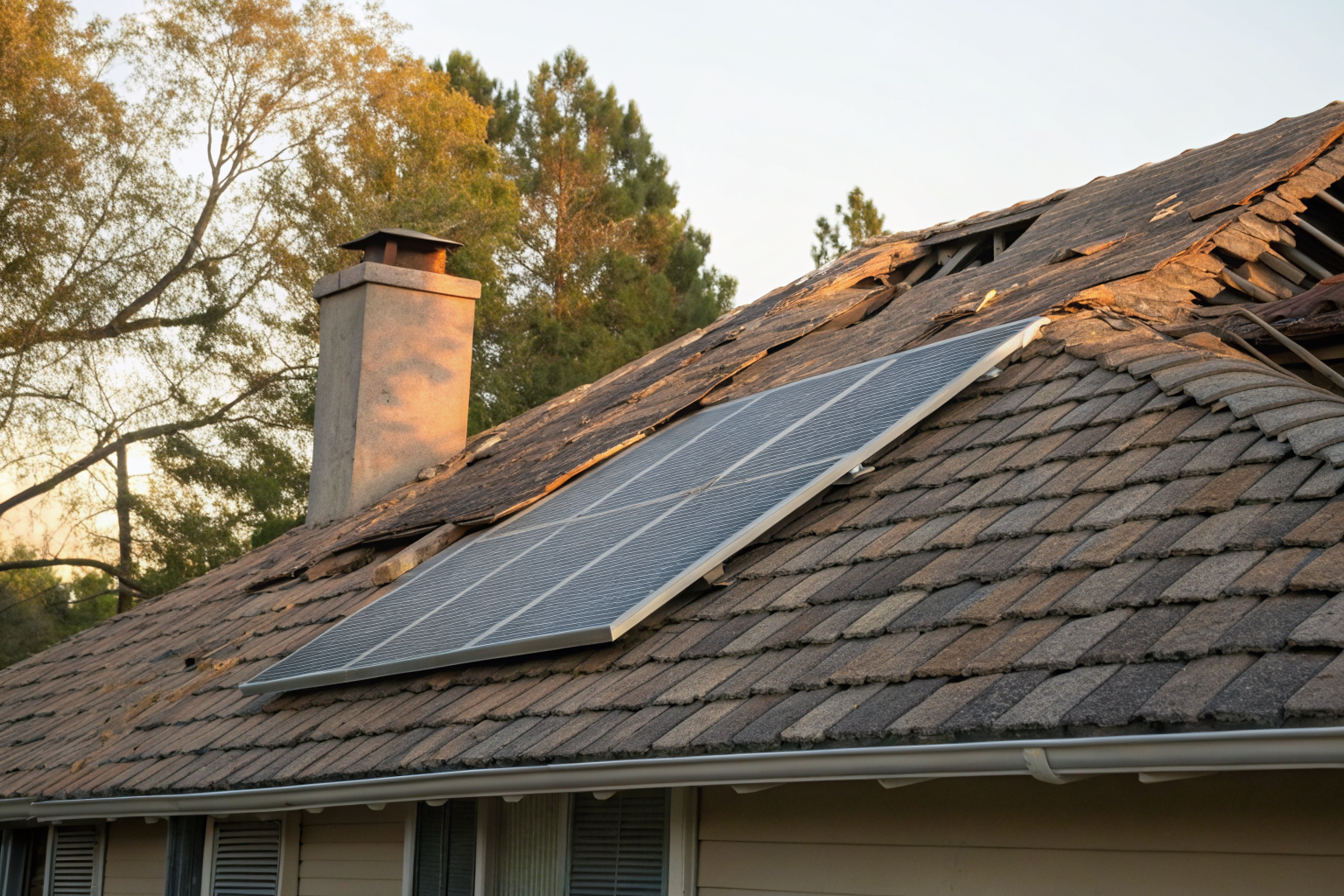
The roof age penalty is not just an underwriting issue. After a denial lands, it becomes a claims dispute tool that carriers use to reduce or eliminate solar payments on the same loss event.
Here is what the denial letter language typically looks like in practice. The carrier will cite the condition of the tile roof underlayment as a “contributing cause” or “pre-existing condition” that worsened the damage to the solar mounting system or the panels themselves. Under that framing, the carrier applies actual cash value (ACV) depreciation to the entire claim rather than replacement cost value (RCV). ACV is the depreciated value of the item at the time of loss. RCV is new-for-old replacement. The difference on a $50,000 solar system can be $15,000 to $25,000.
The key diagnostic question is whether the carrier is using the roof age argument to reduce the solar payment specifically, while treating the roof payment separately. If the denial letter mentions underlayment condition in the section describing the solar panels, that is the flag. The carrier is applying the same depreciation logic to attached equipment that it applies to the structure.
This position is contestable when the solar system was disclosed and a rider was added at the time of installation. The rider or scheduled equipment endorsement is a separate coverage grant. A carrier that accepted the rider premium while knowing the roof’s age has a weaker argument that the underlayment condition voided the solar coverage. That argument belongs in the internal appeal letter.
The mechanics of how underlayment age affects underwriting decisions are documented in DIFI consumer complaint filings and are covered from a different angle in articles focused on roof-claim denials. This article stays focused on what to do after the denial, not how the underwriting decision was made.
Carriers apply a 25-50% age surcharge to homes with roofs over 20 years old, per industry underwriting guidelines. When that logic extends to attached solar equipment, you have grounds to dispute the depreciation calculation in your appeal.
How to File an Internal Appeal After a Solar Claim Denial: The Step-by-Step Path

Arizona homeowners appeal solar claim denials through a formal internal review process before escalating to the ADOI. Under ARS 20-461 and Arizona’s Unfair Claims Settlement Practices Act, carriers must acknowledge a written complaint or inquiry within 10 working days and provide a substantive response within 45 days. That statutory window is your leverage. Here is the process.
Request your full claim file in writing. Carriers must provide the claim documentation under ARS 20-461 et seq. Send the request via email to the adjuster and follow up with a written letter. You need the inspection report, the adjuster’s notes, the denial reason code, and any photographs the carrier took.
Identify the specific denial reason code in the denial letter and match it to the exact policy language the carrier is citing. Do not draft your appeal until you know the precise clause. A denial based on “material misrepresentation” requires different counter-documentation than a denial based on a coverage sublimit.
Gather counter-documentation specific to your denial category. For an undisclosed installation claim, you need the original installation permit on file with the county, your signed disclosure to the agent, and any email or written communication confirming the carrier was notified. For a roof age or valuation dispute, you need a contractor’s written replacement valuation of the solar system and dated photographs from before the damage event.
Draft the internal appeal letter addressed to the claims supervisor, not the adjuster. State the denial reason code, cite the specific policy language you believe entitles you to coverage, attach all counter-documentation, and state the dollar amount you are disputing.
Submit via certified mail and retain proof of delivery. Email alone does not create a clean paper trail for a potential ADOI complaint.
Set a 30-day calendar reminder from the date of submission. If the carrier has not responded within 45 days per ARS 20-461, that procedural failure becomes a separate basis for an ADOI complaint.
Consider having a licensed Arizona insurance professional review the denial letter before you draft your appeal. The carrier’s denial language is precise and the counter-argument needs to match it clause for clause.
When Does the Arizona Department of Insurance Get Involved, and What Can It Actually Do?

The ADOI complaint process is a regulatory review mechanism. This means the ADOI can cite a carrier for improper claims handling, procedural failures, or deficient denial letters. It cannot force a carrier to pay a disputed amount.
That distinction matters for solar disputes. If your carrier denied the claim because the denial letter failed to cite the specific policy clause, or because the carrier missed the 45-day response window under ARS 20-461, the ADOI is the right escalation. The ADOI Consumer Services division handled more than 6,000 complaint files in a recent fiscal year, per ADOI annual report data, and carriers respond differently when a regulatory file is open. Low-to-mid-five-figure disputes often resolve at this stage, not because the carrier is legally required to pay, but because the cost of regulatory scrutiny exceeds the cost of settlement.
To file an ADOI consumer complaint, go to the ADOI online portal at insurance.az.gov. You will need your policy number, the carrier’s name, the claim number, the date of denial, and copies of the denial letter and any appeal correspondence. The ADOI assigns a case number, contacts the carrier, and the carrier must respond within a set window.
What the ADOI cannot do is resolve a coverage interpretation dispute. If the carrier’s position is that your solar panel rider does not cover the specific type of loss you experienced, that is a contract interpretation question. The ADOI will note the dispute and may flag procedural issues, but it will not rule on whether the policy language covers your claim. For that, appraisal, mediation, or litigation are the available paths.
For disputes above $10,000, consult a licensed Arizona public adjuster or insurance attorney before deciding whether ADOI escalation is sufficient on its own.
Should You Hire a Public Adjuster for a Denied Solar Claim in Arizona?

Public adjusters improve disputed solar claim outcomes when the denial involves a valuation disagreement, not a coverage void. The National Association of Public Insurance Adjusters reports that Arizona-licensed public adjusters work on contingency at 10-15% of the final settlement. That fee structure is only worth it when the recovered amount exceeds what you could have recovered through the internal appeal process alone.
Here is when the math and the dispute type make a public adjuster the right call, and when it does not.
Use a public adjuster when the denial is a valuation dispute. If the carrier says your system is worth $18,000 and you paid $47,000, that gap is a public adjuster’s core competency. They commission independent appraisals and negotiate replacement cost documentation with the carrier.
Use a public adjuster when the carrier has cited roof condition as a contributing cause and you believe the solar system itself was undamaged by that condition. A public adjuster can commission an independent inspection to separate the solar damage from any pre-existing underlayment issues, giving you independent documentation to contest the carrier’s depreciation calculation.
Skip a public adjuster when the denial is based on material misrepresentation for non-disclosure. That is a legal and contractual dispute. A public adjuster cannot renegotiate the existence of coverage. An insurance attorney is the right resource, particularly if the carrier is threatening to void the entire policy.
Skip a public adjuster when the system was unscheduled and the carrier is correct that no solar panel rider existed. The dispute is about whether coverage exists at all, not about how much the covered loss is worth. The public adjuster has nothing to negotiate against.
Verify the public adjuster’s license with the ADOI before signing any contingency agreement. Arizona requires public adjusters to hold a license issued by the ADOI. You can confirm license status at insurance.az.gov.
This decision connects to the broader question of how your deductible structure and coverage limits interact with a solar denial. If your carrier raised your deductible at renewal without clear notice, per the patterns described in discussions of carrier raised deductible renewal arizona, that can affect how much of a recovered solar payment you actually receive net of out-of-pocket costs.
The post-denial path for a solar claim shares structure with water damage disputes. If you are also dealing with water intrusion that followed the same storm event, the process described for hardwood floor water damage insurance disputes follows the same internal appeal and ADOI escalation sequence.
Frequently Asked Questions
Does homeowners insurance automatically cover solar panels in Arizona?
A standard Arizona HO-3 policy may extend Coverage A to solar panels as permanently attached equipment, but automatic coverage is not guaranteed. The system must be disclosed to the carrier, and the Coverage A limit must be high enough to cover the replacement cost, which runs $40,000 to $60,000 for a typical residential install. Many policies require a solar panel rider or scheduled equipment endorsement to cover the full system value. Consult a licensed Arizona insurance professional to confirm whether your current policy language covers your specific system.
Can my insurance company deny a solar hail damage claim because my roof is old?
Yes. If your tile roof underlayment is past its serviceable life, Arizona carriers may argue that the solar panel damage was caused or worsened by a pre-existing structural condition. That argument can result in an ACV payment instead of full replacement cost, or a partial denial of the solar portion of the claim. The denial is contestable if the solar system was properly disclosed and a solar panel rider was active at the time of the loss. An independent roof and solar inspection produces the strongest counter-evidence.
How long does an Arizona insurance company have to respond to a claim appeal?
Under ARS 20-461 and Arizona’s Unfair Claims Settlement Practices Act, carriers must acknowledge a written complaint or inquiry within 10 working days and provide a substantive response within 45 days, per ADOI claims-handling regulations. If the carrier misses those windows, that procedural failure becomes a separate basis for an ADOI complaint. The ADOI Consumer Services division enforces these timelines and is the regulatory body to contact when a carrier goes silent after an appeal submission.
If you are planning ahead and want to avoid this situation on your next renewal, the process for solar panel storm damage claim arizona disputes starts with making sure the system is properly scheduled before the storm season, not after. For homeowners without a solar system who want to understand how coverage adequacy works across property and auto lines, the topic of recommended car insurance coverage arizona follows the same disclosure-and-limits logic applied to a different asset class.