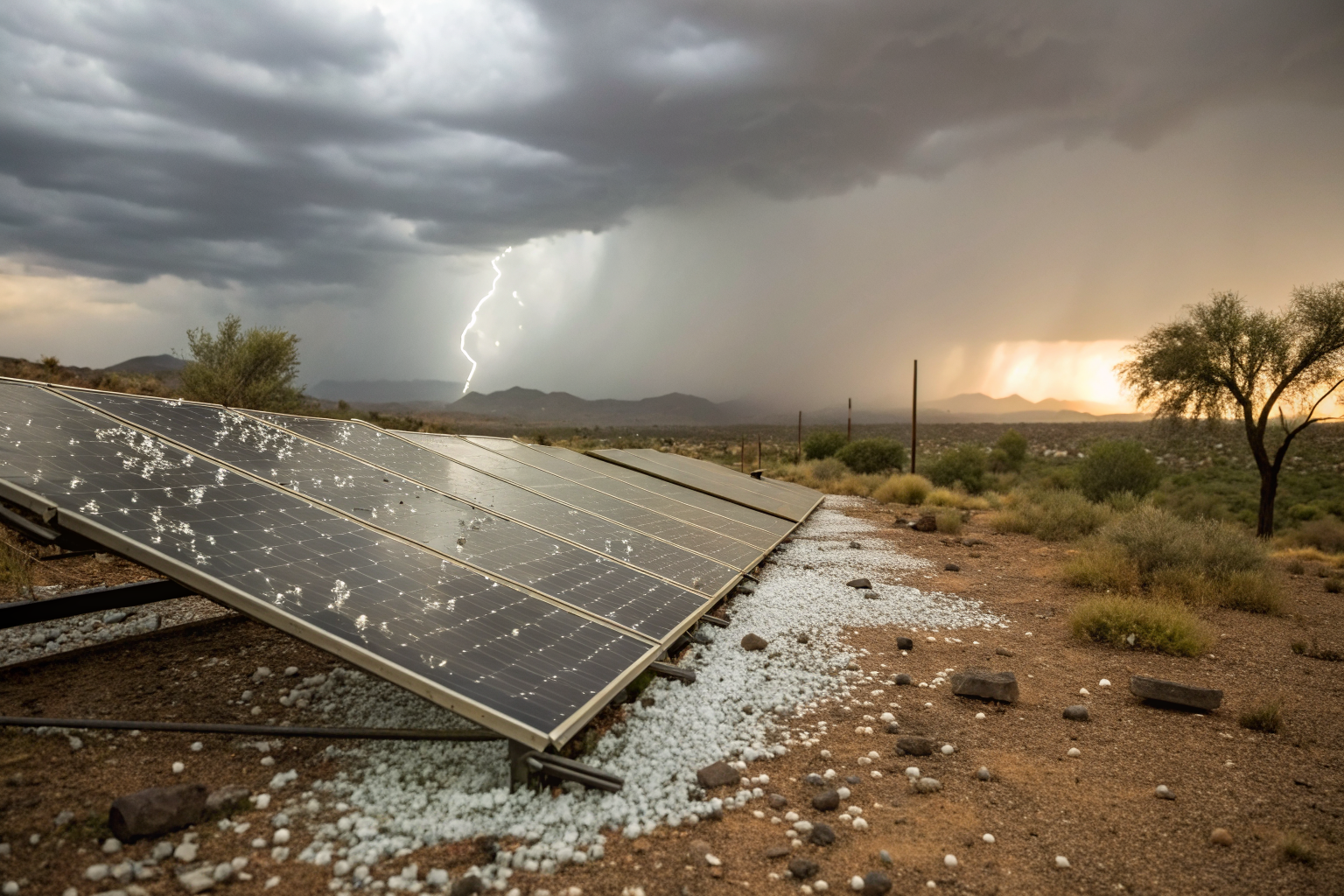
Solar panel storm damage claim Arizona homeowners file after a haboob or hail event is nothing like a standard roof claim. Most adjusters have never settled one. The documentation requirements differ, the exclusions are different, and the payout math can surprise you. Here is what you need to know before you call your carrier.
Key Takeaways:
- Most standard HO-3 policies treat a solar array as Coverage A (dwelling), but only if the system was disclosed at application, an undisclosed $40,000–$60,000 system can produce a partial or voided payout regardless of the storm damage.
- Residential PV panels rated Class 1 can crack under hail as small as 1 inch in diameter; Class 4 panels withstand up to 2-inch hail, the grade on your array determines whether visible cracking is a covered loss or a cosmetic exclusion.
- Arizona monsoon wind gusts regularly exceed 60 mph, and the IBC racking standard requires arrays to withstand local wind loads, if your racking was installed to a lower specification, the carrier may invoke a faulty-workmanship exclusion rather than paying the wind claim.
What Does Hail Damage to Solar Panels Actually Look Like, and Does It Trigger a Claim?

Hail impact rating determines whether cell cracking is a covered loss or a cosmetic exclusion. That one fact separates a paid claim from a denial letter, and most homeowners do not know their panels have a rating at all.
Residential PV panels are tested under the UL 61730 or IEC 61215 hail impact protocol and assigned a class rating from 1 to 4. Class 1 panels fail under approximately 25mm (roughly 1-inch) hailstones per IEC 61215 test protocol. Class 4 panels are rated to 50mm (roughly 2-inch) impacts. The grade your installer used is on the spec sheet stapled to your permit, pull that document before you file anything.
The class rating matters to your carrier because it sets the threshold for what counts as storm-consistent damage versus pre-existing degradation. A Class 1 array hit by a Phoenix storm that drops 1.5-inch hail is physically expected to crack. A Class 4 array hit by the same storm is not, and if it cracks anyway, the adjuster will look hard at whether the damage pre-dates the event.
Here is what to look for when you inspect your array after a storm:
- Micro-cracks (spider-web cell fractures): These are not visible from the ground. You need to get to roofline height and inspect under raking light or a UV lamp. Micro-cracks cause output degradation that shows up in your inverter logs even when the glass surface looks intact.
- Shattered tempered glass cover: This is the obvious one, visible from the ground, unambiguous physical damage. Most carriers treat shattered cover glass as a covered windstorm or hail loss when it is consistent with the storm event.
- Delamination bubbles: Moisture intrusion from cracked glass causes the cell laminate to separate from the backsheet, creating visible bubbling. This is a functional loss, not cosmetic.
- Discoloration or burn marks: Arc faults from cracked cells produce localized heat. Brown or black marks on the cell surface indicate electrical damage, which is covered under the HO-3 homeowners insurance policy as a sudden and accidental loss in most filed forms.
- Surface scratching on intact glass: Debris abrasion that leaves scratch marks on the glass without fracturing the tempered cover or the cell beneath it is the one category that typically does not trigger a covered claim. Most filed HO-3 forms exclude cosmetic damage, and carriers use this exclusion aggressively on solar glass.
The line your carrier draws is functional versus cosmetic. Cell-level cracking that shows degraded output in your inverter logs is a functional loss. Surface scratching with no cell fracture below it is cosmetic. Know which category your damage falls into before the adjuster arrives.
For context on how roof age factors into the broader claim picture, the article on roof age homeowners insurance Arizona covers the 25–50% age penalty that sometimes bleeds into attached-equipment assessments.
Monsoon Wind Load, Racking Failure, and What Arizona Carriers Actually Cover
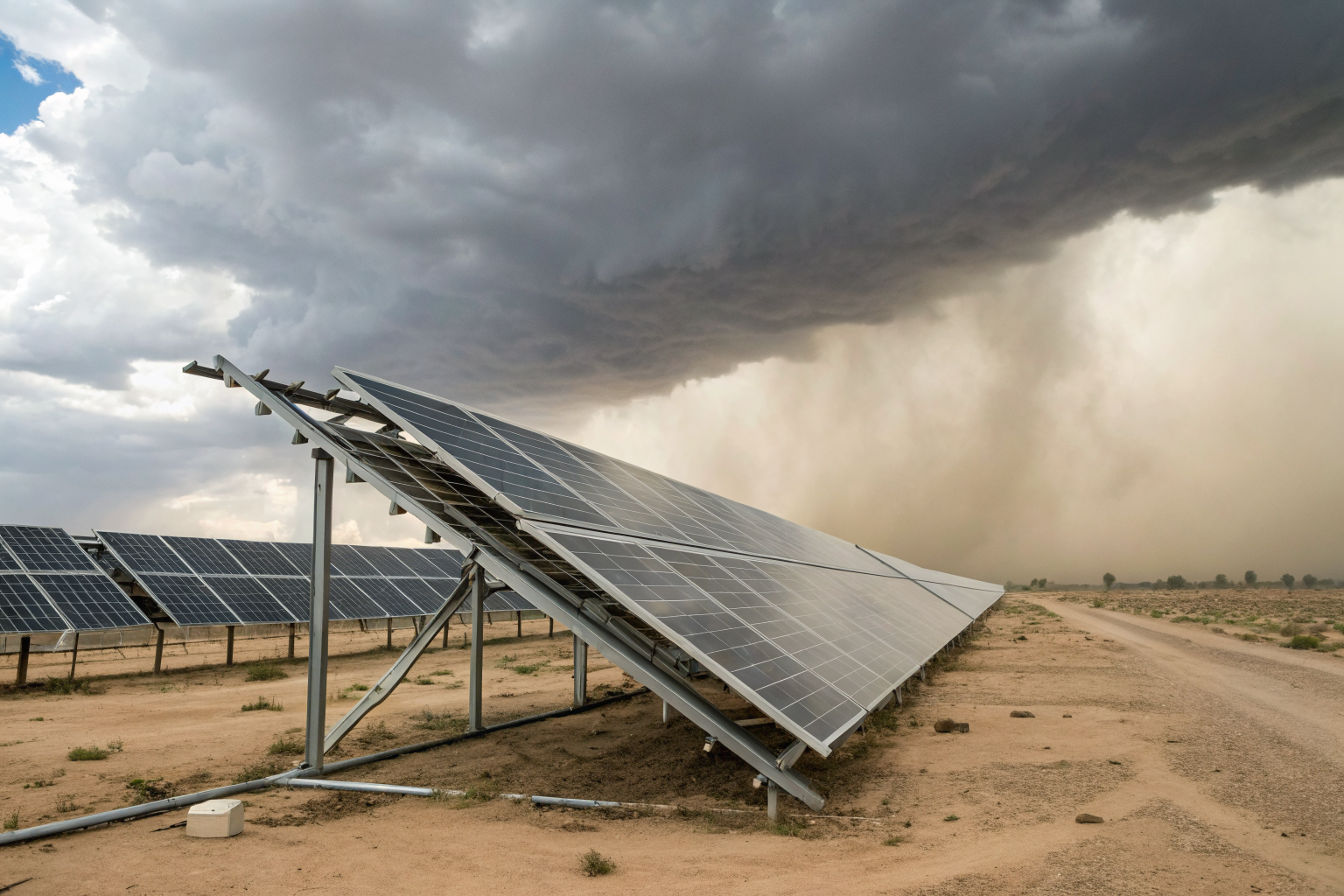
Monsoon wind gusts exceed IBC racking minimums in Phoenix metro haboobs, and that gap in installation spec creates a faulty-workmanship exclusion trigger that can kill the racking portion of your claim.
Phoenix monsoon straight-line winds in haboobs regularly hit 60–75 mph. The International Building Code sets the ground-mounted and roof-mounted racking standard for residential solar based on local wind loads, and in Maricopa County those loads are defined by ASCE 7-22 wind speed maps. Depending on your ZIP code, the design wind speed requirement runs 90–110 mph. That sounds like a comfortable margin above 75 mph haboob winds, until you look at how budget installs were spec’d.
Most residential racking installations completed between 2018 and 2022 were engineered to the 90 mph threshold, the lower end of the Maricopa County range. At that spec, a strong haboob with measured gusts above 90 mph creates an engineering failure, not a weather event, in the carrier’s view. The HO-3 homeowners insurance policy contains a faulty-workmanship exclusion that applies when a system fails because it was built below the applicable code standard. Adjusters trained on solar claims know to pull the install permit and check the racking engineer’s stamp.
Two racking failure patterns show up most in Phoenix metro claims. The first is ballasted flat-roof arrays that shifted because the dead-load calculation was undersized for the actual roof surface, the panels slide or tip without penetrating the roof membrane. The second is penetration-mounted pitched-roof arrays where lag bolts were driven into rafter misses (into sheathing only), and the pull-out force from wind stress causes the mount to fail at the attachment point.
One thing to understand clearly: wind damage to the panels themselves is treated differently from racking failure. If debris impact in the same storm shatters panel glass, that is a windstorm peril claim and typically covered. If the racking system fails because it was under-spec’d for the wind load, the carrier separates that out and applies the workmanship exclusion to the racking repair cost.
The material misrepresentation angle matters here too. If the array was never disclosed to the carrier at application or renewal, the entire PV-related wind claim is at risk, not just the racking. This connects directly to the disclosure mechanics covered in the arizona insurance guide pillar, and it is the first thing to resolve before you file.
How to Document a Solar Panel Storm Damage Claim in Arizona: The Exact Workflow

The claim documentation workflow determines whether the adjuster accepts or disputes the scope of PV damage. Submit the right evidence package at first notice of loss and you control the narrative. Submit it piecemeal after the initial estimate is written and you are arguing uphill.
Follow these steps in order:
- Do not let anyone touch the array before photos are taken. A roofer or solar contractor who climbs on the array before you document it voids the adjuster’s ability to assess original damage. Keep everyone off the roof until you have a complete photo record.
- Photograph from ground level and from roofline height. Capture every panel face, every racking attachment point, all conduit runs, and the inverter box. Ground-level shots establish overall context; roofline shots capture micro-cracks and delamination that are invisible from the street.
- Pull the inverter production log the same day. Enphase and SolarEdge monitoring platforms store per-panel output data for a minimum of 10 years, downloadable as a CSV. A post-storm output drop on specific panels is the single best evidence of functional damage versus cosmetic scratching. This log is more defensible than any visual inspection report.
- Cross-reference the storm event with the NWS Phoenix Doppler radar archive. Note the date and time of the storm and download the relevant radar capture. This ties your damage to a specific weather event, which matters when the carrier argues pre-existing degradation.
- Request a solar-certified adjuster or a third-party PV inspector in writing. General property adjusters miss micro-cracks. Put your request for a solar-qualified inspector in your claim notes at the first call and follow up by email so there is a written record.
- Submit the full documentation package at first notice of loss. The package should include: inverter output log (pre- and post-storm), timestamped photos, original install permit showing panel class and racking spec, and the NWS radar printout. If your array runs through a solar panel rider or scheduled equipment endorsement rather than plain Coverage A, the declarations page will show which settlement path applies, the claim form requirements may differ slightly between the two.
A caveat worth flagging: if your panels are older than 10 years, the carrier may argue that output degradation in the inverter log is normal age-related decline, not storm damage. Pre-storm baseline data from your monitoring platform is the counter to that argument. Pull 90 days of pre-storm output history and include it in the package.
For cross-reference, the same documentation discipline applies when water from a cracked conduit penetration gets into the roof deck, the hardwood floor water damage insurance article covers what happens when water paths from roof damage reach interior finishes.
How Are Solar Panel Storm Claims Actually Paid Out, ACV, RCV, and the Deductible Math

Settlement basis (ACV vs. RCV) determines your actual out-of-pocket cost after a solar panel storm claim, and the difference on a $50,000 array can exceed $14,000 before your deductible applies.
On a $50,000 solar array settled on an actual cash value basis at 7 years of age with a 25-year useful life, the depreciation holdback before the deductible is approximately $14,000, meaning a homeowner with a $5,000 wind/hail deductible nets roughly $31,000 on a total-loss claim. That math surprises most homeowners who assumed their policy paid new-for-old.
Here is how the three main settlement scenarios compare:
| Feature | Coverage A (RCV) | Coverage A (ACV) | Solar Panel Rider |
|---|---|---|---|
| What the carrier pays initially | Depreciated value; holds back until repair completed | Depreciated value only; no holdback release | Depends on rider terms; often scheduled RCV up to the listed limit |
| Depreciation on a 7-year-old array (25-yr life) | ~28% withheld at first payment; released after repair | ~28% permanently deducted; no recovery of holdback | Varies; some riders use RCV, some use ACV, check the declarations page |
| Deductible application | Single wind/hail deductible applies to combined dwelling loss (roof + panels in same occurrence) | Same single deductible, applied to the lower ACV payout | May carry its own separate deductible; check the rider schedule |
| Risk of roof age penalty bleed-over | Carrier may try to apply roof age surcharge to attached racking | Same risk | Racking typically scheduled separately; age penalty less likely to transfer |
| Best for systems valued $40,000+ | Acceptable if policy limit covers full replacement cost | Problematic, large depreciation gap on high-value arrays | Cleanest path for high-value arrays; own limit, own settlement terms |
One specific mechanic to watch: if a monsoon event damages both the roof and the panels in the same occurrence, most carriers apply a single wind/hail percentage deductible to the combined dwelling loss. On a $500,000 home at 2%, that is $10,000 before the first dollar pays, and it applies to the total roof-plus-panel repair scope, not just the panel portion.
The roof age penalty is a separate issue. Carriers apply a 25–50% surcharge to homes with roofs over 20 years old, as detailed in the article on roof age homeowners insurance Arizona. That penalty does not transfer to the solar claim by policy language, but adjusters sometimes apply it to the attached racking system in the initial estimate. Flag any age-penalty line item on racking as a scope dispute and ask the carrier to cite the specific exclusion in writing before you accept a partial payment.
If you are unsure how your current policy settles a PV claim, the annual review process the arizona insurance guide covers is the right time to find out, before the storm, not after.
How to File a Solar Panel Storm Damage Claim in Arizona: Start to Finish

Filing a solar panel claim requires the original install permit, inverter log, and a solar-certified adjuster request to avoid scope disputes. These three items separate a clean claim from a protracted one.
- Confirm the policy covers the array before you file. Check the declarations page for a solar rider, scheduled equipment endorsement, or Coverage A language covering permanently attached equipment. If the system was never disclosed and is not on the policy, filing without disclosing it first can harden a denial into a material misrepresentation finding, which is a harder problem than a coverage gap.
- Call the carrier and request a solar-certified adjuster or PV field inspector by name in the claim notes. Follow up that verbal request with an email to create a written record. General adjusters handling solar claims frequently scope only visible glass damage and miss the cell-level and racking issues that represent the bulk of the loss.
- Submit the full documentation package at first notice of loss, not piecemeal. The package should include your inverter logs (pre- and post-storm baseline), timestamped photos from roofline height, the NWS Phoenix radar archive for the storm date, and the original install permit showing panel class and racking engineering spec. Claims where homeowners submit the inverter log at first notice of loss are disputed at a lower rate than claims where the log arrives after the initial adjuster estimate is already written.
- Review the initial adjuster estimate line by line before responding. Scope creep exclusions show up in the first estimate: cosmetic glass scratching exclusions, pre-existing micro-crack arguments, and racking repair denials based on workmanship language. These are easier to dispute before you accept the estimate than after.
- If the estimate excludes racking repair on wind-damage grounds, ask the carrier to cite the specific policy exclusion language in writing. The HO-3 faulty-workmanship exclusion requires the carrier to point to the actual contract language. If the racking was installed to code and the install permit confirms the engineering spec, the workmanship exclusion does not apply and the written citation request forces the adjuster to prove their basis.
For riders specifically: if your array runs on a scheduled equipment endorsement rather than plain Coverage A, the claim form may require a replacement cost estimate from a licensed solar contractor rather than a general roofing contractor. Confirm which documentation format the rider requires before you submit.
This same diligence applies to other coverage areas. If you are reviewing your policy after a storm event, the recommended car insurance coverage Arizona and motorcycle insurance checklist Arizona articles cover parallel disclosure and documentation principles for your other vehicles.
Frequently Asked Questions
Does a standard Arizona homeowners policy automatically cover solar panels, or do I need a separate rider?
Most filed HO-3 forms treat permanently attached solar panels as part of Coverage A, the structural portion of the dwelling, which means the system is covered if it was disclosed when the policy was written or at a subsequent renewal. If the array was never added to the policy, the carrier can deny the storm claim on material misrepresentation grounds regardless of how severe the damage is. A solar panel rider or scheduled equipment endorsement gives the array its own coverage limit and settlement terms, which is the cleaner path for systems valued at $40,000 or more.
Can Arizona monsoon wind damage void a solar panel claim if the racking was installed incorrectly?
Yes. If the racking system was installed below the wind load specification required by the International Building Code for your Maricopa County address, most carriers will invoke the faulty-workmanship exclusion in the HO-3 and decline to pay for racking failure, even if the wind event itself was a covered peril. Panel damage from debris impact in the same storm is treated as a separate covered loss. The install permit and racking engineering spec are the documents that decide which side of that line your claim falls on.
What is the difference between Class 1 and Class 4 solar panels when it comes to an insurance claim?
The class rating refers to the UL 61730 or IEC 61215 hail impact test standard. Class 1 panels are rated to withstand roughly 1-inch hailstones; Class 4 panels handle up to 2-inch impacts. If your panels are Class 1 and Phoenix receives a storm with 1.5-inch hail, cracking is physically expected and covered as storm damage. Carriers use the panel class documented on the original install permit to evaluate whether damage is consistent with the storm event or pre-existing, mismatches between reported damage and rated tolerance are a common basis for scope disputes.