Pool liability insurance Arizona homeowners need goes well beyond what a standard policy provides. Arizona has more residential pools per capita than nearly any other state, and most owners have no idea their HO-3 carries a $100,000 ceiling on a lawsuit that can easily top $500,000.
Key Takeaways:
- A standard Arizona HO-3 policy carries $100,000–$300,000 in personal liability, a single pool drowning lawsuit in Maricopa County can exceed $1,000,000 in damages, leaving the gap entirely on you.
- The attractive-nuisance doctrine holds Arizona homeowners liable for trespassing children injured in a pool, regardless of whether you invited them, fencing alone does not eliminate the exposure.
- A $1 million personal umbrella policy costs roughly $150–$300 per year in Arizona, but carriers require the underlying HO-3 liability to sit at a minimum threshold, usually $300,000, before the umbrella attaches.
This article is part of The Gebhard Agency’s broader arizona insurance guide for Phoenix-metro homeowners. If you also rent your home short-term, the airbnb insurance arizona rules layer on top of everything covered here, that’s a separate, more complex exposure stack.
What Does Arizona Homeowners Insurance Actually Cover When Someone Gets Hurt in Your Pool?
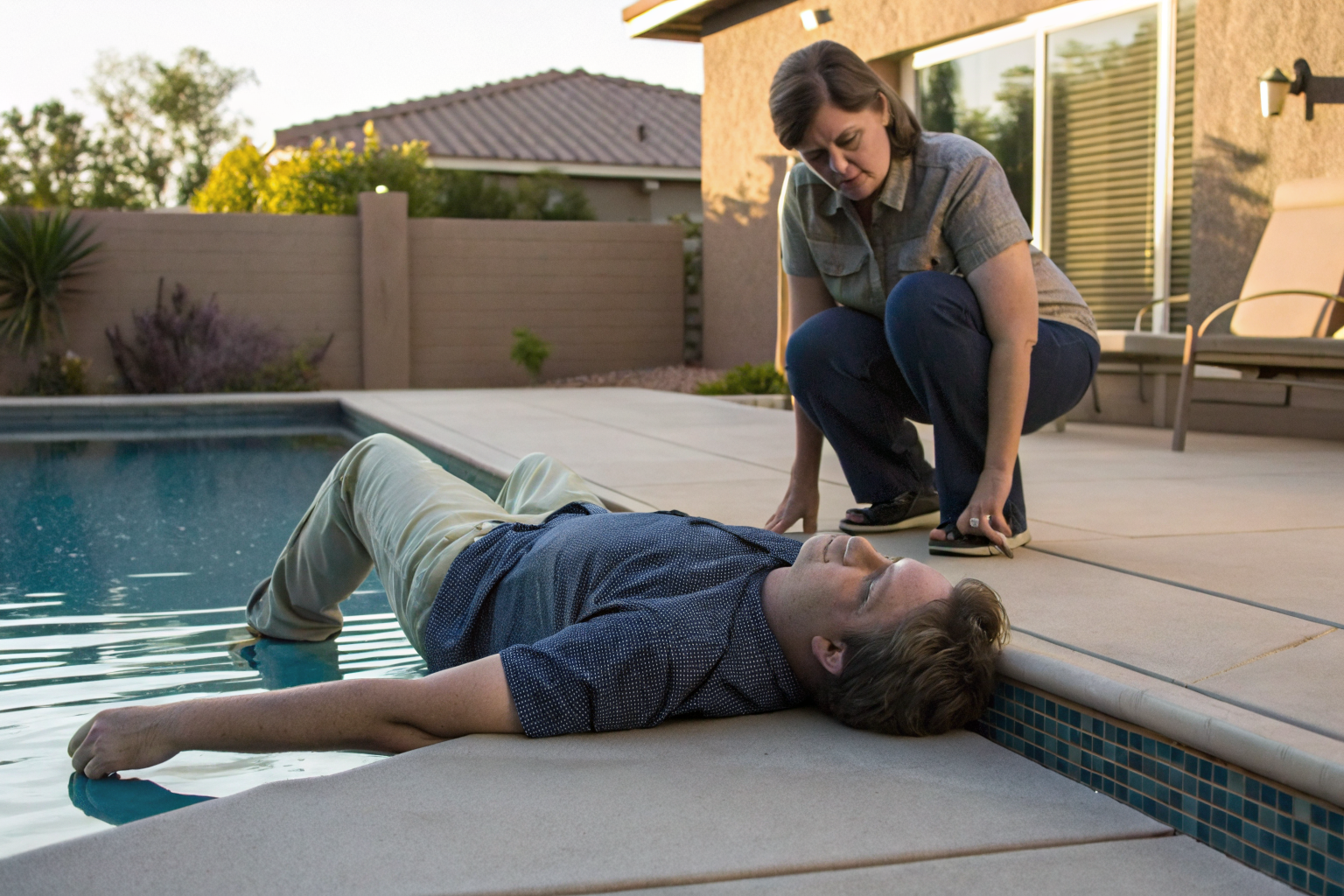
Coverage E, the personal liability section of a standard HO-3 policy, is defined as the insurer’s obligation to pay damages and provide a legal defense if you are found liable for bodily injury or property damage to a third party. This means that if a guest slips on your pool deck, breaks an arm, and sues you, Coverage E pays your attorney’s fees plus any judgment or settlement, up to the stated limit.
That limit matters enormously. The default Coverage E limit on a standard HO-3 policy is $100,000. Most Arizona carriers allow buyers to elect $300,000 at a modest premium increase, and a small number go higher. These figures are consistent with NAIC filed policy form structures across the leading AZ-filed HO-3 forms. On a pool-drowning lawsuit, $100,000 is not a safety net. It is a starting point for what you may owe after the policy pays out.
Coverage F, the medical payments section, works differently. Coverage F is a no-fault medical payment, typically $1,000–$5,000, that pays a visitor’s medical bills without requiring a finding of negligence. Think of it as goodwill coverage for minor injuries. It is not a litigation shield. A guest who accepts a $2,000 medical payment under Coverage F can still sue you under Coverage E for the full value of the injury.
Neither Coverage E nor Coverage F was designed with pool-drowning litigation in mind. Arizona courts have awarded damages well above standard HO-3 limits in pool-injury cases, though exact verdicts vary by the specific facts involved. The liability limits structure on a default HO-3 leaves a meaningful gap between what the policy pays and what a jury can award. Consult a licensed Arizona insurance agent and an Arizona-licensed attorney for guidance specific to your property and situation.
The Attractive-Nuisance Doctrine: Why a Fence Doesn’t End Your Arizona Pool Liability
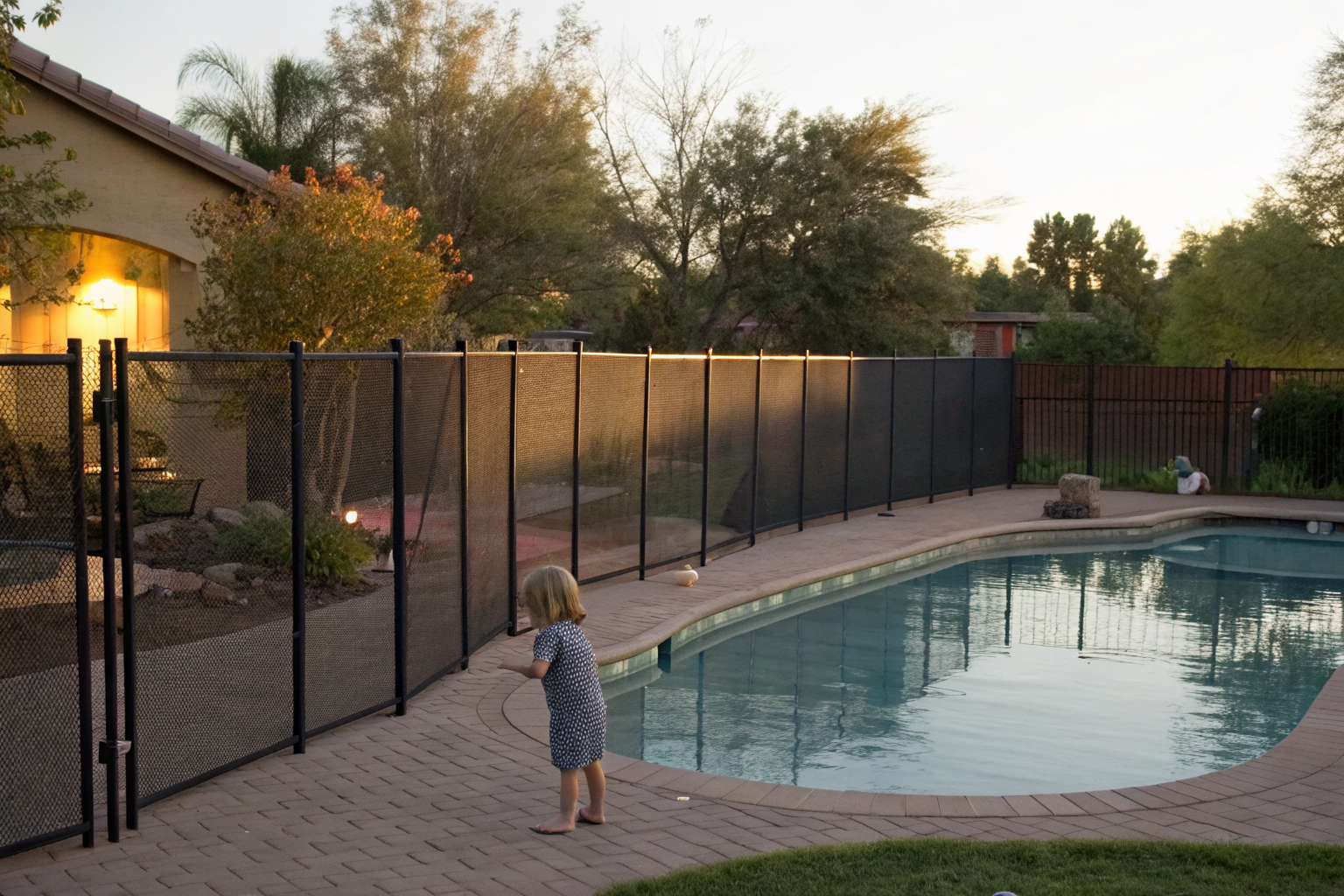
Arizona follows the Restatement Second of Torts Section 339 framework for attractive-nuisance claims. Under that framework, a homeowner can be held liable for injuries to a trespassing child if five factors are met: the hazard exists in a place where children are likely to trespass; the owner knows or should know the condition poses an unreasonable risk of death or serious injury; children, because of their age, do not recognize the danger; the burden of eliminating the danger is slight compared to the risk; and the owner fails to exercise reasonable care.
A swimming pool satisfies the first two factors almost by definition in any Arizona residential neighborhood. Children are drawn to water. The risk of drowning is not subtle. The analysis then turns on whether the child was old enough to appreciate the danger and whether the homeowner took reasonable steps to reduce the risk.
This is where the fence misunderstanding enters. A compliant fence satisfies Maricopa County’s pool barrier code requirement under ARS 36-1681. It is a meaningful risk-reduction measure, and it demonstrates that you exercised some degree of care. A fence is a mitigation factor, not a legal shield. Under the Restatement Section 339 test, a compliant fence can weigh in your favor on the reasonable-care prong, but it does not automatically defeat the claim. If a child unlatches the gate, climbs over, or enters through a gap and is injured, the attractive-nuisance analysis proceeds on all five factors.
The practical result: an owner-occupier with a fully code-compliant pool still carries meaningful liability exposure to injured child trespassers. The liability limits structure on a standard HO-3 does not account for this. That gap is precisely why umbrella coverage exists for pool-owning Arizona homeowners. You may want to consult an Arizona attorney to understand how the attractive-nuisance doctrine applies to the specific features of your property.
Arizona Pool Fence Code and Carrier Underwriting: What Compliance Actually Costs You at Renewal

The Arizona Pool Safety Act (ARS 36-1681 through 36-1686) sets the statewide baseline for residential pool barriers. The law requires a minimum 5-foot fence or barrier surrounding the pool, a self-latching and self-closing gate that opens away from the pool, and no direct access from the dwelling to the pool area through a standard door, unless that door is equipped with a CPSC-compliant alarm that sounds when the door opens.
Carriers treat compliance as an underwriting factor, not a courtesy check. A pool property that passes an exterior inspection, including aerial imagery review, which most major AZ carriers now conduct at quote and renewal, gets underwritten as a standard risk. A property with a missing gate latch, a fence under 5 feet, or an unalarmed direct-access door gets flagged. The carrier’s response depends on the severity of the violation.
| Compliance Status | Carrier Action | Effect on Liability Coverage |
|---|---|---|
| Fully compliant (ARS 36-1681 standards met) | Standard underwriting, no surcharge | Full Coverage E at elected limit |
| Partially compliant (e.g., gate latch missing, door alarm absent) | Surcharge or 30-day cure letter | Coverage may continue pending correction; failure to correct can trigger non-renewal |
| Non-compliant (barrier under 5 feet, no enclosure) | Coverage exclusion or non-renewal | Pool-related liability claims may be denied |
Material misrepresentation enters the picture at claim time. If a homeowner fails to disclose a non-compliant barrier at application or renewal, and the carrier discovers the violation during a claim investigation, the carrier can assert a material misrepresentation defense to deny the claim. This is not a theoretical risk. Carriers pull aerial inspection imagery before and after claims. A fence violation that pre-dates the claim gives the carrier grounds to void pool-related coverage retroactively.
Speak to your insurance agent before making any fence changes. The sequencing of the upgrade and the policy disclosure matters, a mid-term improvement that goes undisclosed until claim time can still create a misrepresentation problem if the carrier contends you knew about the deficiency earlier.
This underwriting dynamic also ties into the pattern described in our article on how a carrier raised deductible at renewal without notice. Carriers can adjust your terms based on inspection findings, and pool-barrier issues are one of the cleaner triggers for mid-cycle underwriting action in Arizona.
How Much Umbrella Do You Actually Need for an Arizona Pool? The Sizing Math

A $1 million personal umbrella policy costs roughly $150–$300 per year in Arizona for the first million in coverage, and roughly $75–$150 for each additional million. Those are industry-reported ranges, not a guaranteed quote. Get an actual quote from your agent before making a decision. What the numbers establish is that the cost of umbrella coverage is low relative to the exposure a pool creates.
The personal umbrella policy attaches above the underlying HO-3 liability limit to extend total coverage. It does not replace Coverage E. It sits on top of it. Most carriers require the underlying HO-3 to carry at least $300,000 in personal liability before the umbrella attaches, which means step one is confirming your HO-3 limit is high enough to qualify.
Here is the sizing methodology:
- Calculate your net worth. Add up your assets (home equity, savings, investment accounts, vehicles) and subtract your liabilities. That number is what a plaintiff’s attorney can target above your insurance limits in a judgment.
- Confirm your HO-3 Coverage E limit meets the umbrella’s attachment threshold. Most umbrella carriers require $300,000 in underlying personal liability before the policy attaches. If your HO-3 is sitting at the default $100,000, raise it first.
- Set the umbrella floor at $1 million, minimum. For any Arizona homeowner with a pool, $1 million is the starting point, not a stretch goal. A pool drowning case with a young child can produce damages well above that, but $1 million is the baseline for a pool-only exposure.
- Add $1 million per additional exposure layer. A dog on the property adds liability (see our article on dog bite insurance arizona for the ARS 20-1510 underwriting changes). A trampoline adds more. Each compound exposure layer justifies another million in umbrella coverage.
- Check the umbrella form for pool-specific exclusions. Some carriers exclude claims arising from swim lessons, commercial pool use, or specific features like diving boards. Confirm the form covers your pool as it exists today before you rely on it.
This sizing approach applies to owner-occupier scenarios. If you are running a short-term rental, the exposure stack changes. The snowbird home insurance mistakes arizona article covers vacancy-period liability gaps that apply when the home sits empty part of the year, which is a separate sizing question.
What Arizona Carriers Actually Look for When Underwriting a Pool Property

Arizona pool underwriting evaluates physical property features, compliance records, and prior claims history before assigning a rate or deciding whether to write the policy at all. Carriers pull CLUE (Comprehensive Loss Underwriting Exchange) reports at quote and at claim time. According to LexisNexis Risk Solutions, CLUE reports include up to 7 years of prior claims on a property. A pool-related prior claim on the CLUE report triggers underwriting review at renewal.
Here is what the underwriting checklist covers:
- Fence and barrier compliance status. Carriers check ARS 36-1681 compliance through exterior inspection or aerial imagery. A non-compliant barrier is a red flag at quote and a material misrepresentation issue at claim.
- Presence of a slide or diving board. Many carriers surcharge these features or exclude claims arising from them. A diving board on a pool that is under 8 feet deep creates an exposure most carriers price separately or decline to cover.
- Pool depth over 8 feet. Deeper pools present greater drowning and diving-injury risk. Carriers that do write deep pools may apply a liability surcharge.
- Prior pool-related claims on the CLUE report. Even a single pool-injury claim on the property’s history can trigger non-renewal or a premium increase at the next cycle, regardless of who was at fault.
- Year-round heating. A heated pool is a year-round exposure. In Arizona’s climate, an unheated pool is largely a summer risk. Carriers that ask about heating are measuring the full annual exposure period.
- Owner-occupancy versus rental use. A pool on an owner-occupied property is underwritten differently than one on a property with tenants or short-term guests. Even occasional Airbnb use can void pool-related coverage under a standard HO-3, the same entrustment exclusion issue covered in the airbnb insurance arizona cluster.
- Whether the HO-3 liability limit meets the umbrella attachment floor. Carriers writing the umbrella confirm that the underlying HO-3 carries the minimum Coverage E limit. If it does not, the umbrella carrier may decline to write the policy or require you to increase the underlying limit first.
Consult your agent before adding any pool feature. The underwriting disclosure obligation exists before you install it, not after. A diving board that goes undisclosed and later surfaces during a claim investigation gives the carrier grounds to deny coverage on material misrepresentation. This is the same disclosure logic that applies to solar panels (see the solar panel storm damage claim arizona thread) and to slow leaks that predate a slow leak vs burst pipe coverage dispute.
Frequently Asked Questions
Does homeowners insurance cover a pool drowning in Arizona?
Personal liability coverage under Coverage E on a standard Arizona HO-3 pays legal defense costs and damages up to the stated limit, typically $100,000 to $300,000, if a drowning results in a lawsuit against you. The problem is that pool drowning cases in Arizona can produce damages well above those limits, leaving you responsible for the gap. A personal umbrella policy extending total coverage to $1 million or more is the standard recommendation for any Arizona homeowner with a pool.
Does an umbrella policy cover pool accidents in Arizona?
A personal umbrella policy covers pool-related bodily injury claims in Arizona, but only after the underlying HO-3 liability limit is exhausted, and the umbrella carrier requires that underlying limit to meet a minimum threshold, usually $300,000, before the policy attaches. Some carriers impose exclusions for commercial pool use, swim lessons, or specific features like diving boards, so you need to confirm the umbrella form covers your specific situation. Consult a licensed Arizona insurance agent to verify that your umbrella policy has no pool-specific carve-outs.
Can I be sued if a kid trespasses and drowns in my Arizona pool?
Yes. Under Arizona’s attractive-nuisance doctrine, which follows the Restatement Second of Torts Section 339 framework, a homeowner can be held liable for injuries to a trespassing child if the pool constitutes a foreseeable hazard that the child is too young to recognize as dangerous. A compliant fence reduces the risk and satisfies the Maricopa County pool barrier code under ARS 36-1681, but it does not eliminate the legal exposure. You may want to consult both a licensed Arizona insurance agent and a licensed Arizona attorney to understand how your specific property’s features affect your liability profile.