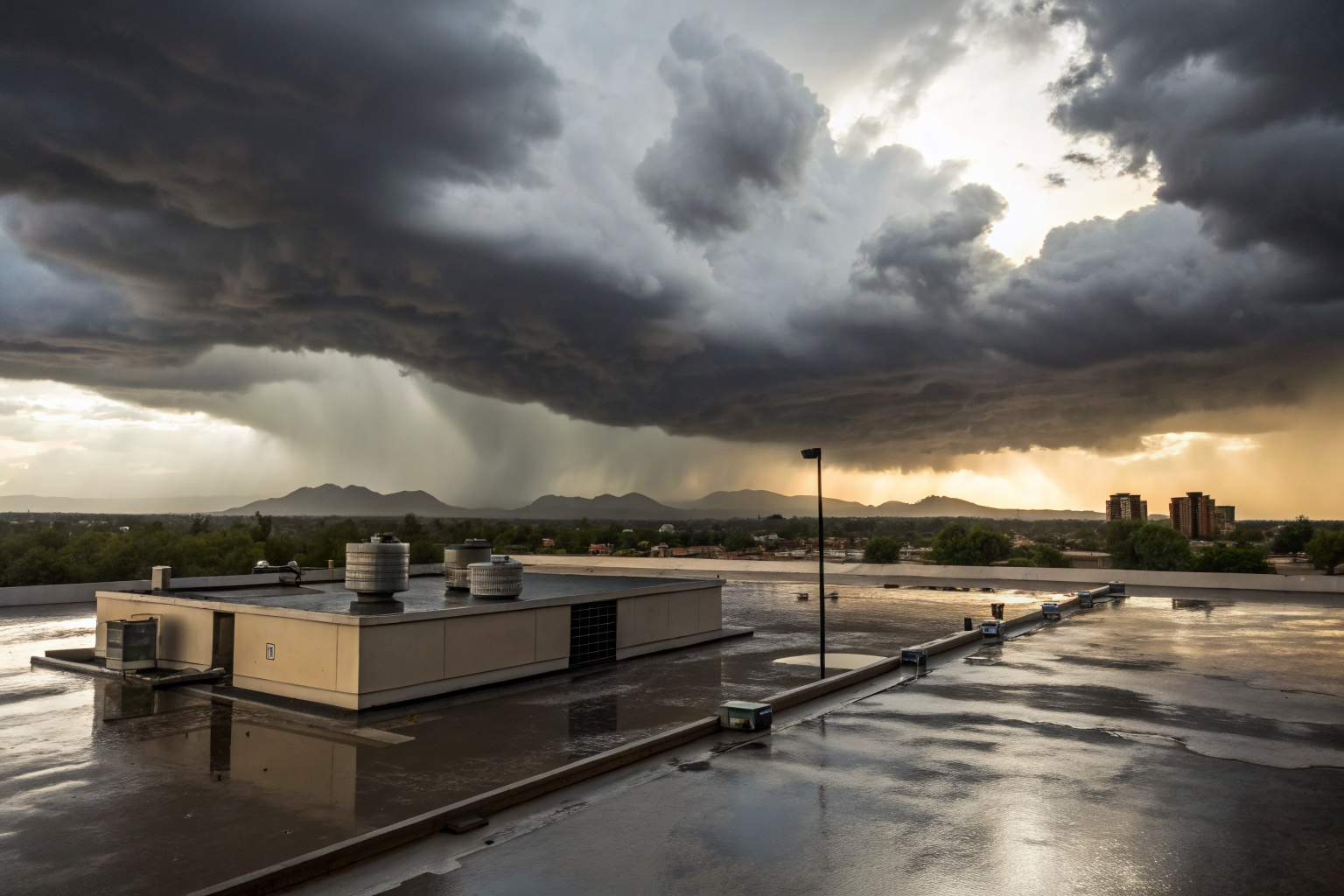
Commercial flat roof monsoon damage is the claim Phoenix metro business owners file expecting a check and receive a coverage dispute instead. Phoenix monsoon season drops 2-3 inches of rain in under an hour on flat commercial roofs designed to shed water slowly, and when the drain can’t keep up, what follows is rarely straightforward.
Key Takeaways:
- Commercial wind/hail deductibles on Phoenix metro policies typically run 1-5% of the building’s insured value, on a $1 million warehouse, that’s $10,000-$50,000 out of pocket before coverage starts.
- Ponding water that sits longer than 48 hours after a monsoon event is excluded under the gradual damage clause of standard commercial property forms, not the flood exclusion.
- Business interruption coverage has a 48-72 hour waiting period before it triggers; a monsoon that forces a two-day closure may produce zero payout.
If you are still working out which deductible applies to your property, the monsoon deductible Arizona article covers the residential side of percentage deductible structure in detail. For a full picture of how commercial coverage fits into your overall protection, the Arizona insurance guide is the right starting point.
How Flat-Roof Ponding Mechanics Turn a Monsoon Into a Denied Claim

Ponding is standing water that remains on a flat roof surface 48 or more hours after precipitation ends. This means any water sitting on your membrane two days after a monsoon event is no longer a storm-damage claim in most carriers’ eyes, it is evidence of a drainage or maintenance problem.
The sequence plays out like this: AZ monsoon season delivers a fast, high-volume rain event. The internal roof drains, sized for normal rainfall rates, cannot clear three inches of water in ninety minutes. Water pools across the membrane. The membrane deflects under the load, creating low spots where water concentrates further. Seepage begins through the membrane or through flashing joints. By the time the adjuster inspects, the storm is long past and the standing water tells a story the carrier uses against the claim.
The critical distinction most Phoenix business owners miss is that this is not a flash-flood claim. The flash flood exclusion applies when water enters a building from external flooding, rising water from streets or drainage channels. Flat-roof ponding seepage is handled under a different clause entirely. The ISO CP 00 10 commercial property form excludes loss caused by continuous or repeated seepage or leakage of water that occurs over a period of 14 days or more. Adjusters use that clause when they find pre-existing drain blockage, algae buildup on the membrane, or drain logs that show no maintenance in the prior season.
Phoenix metro commercial flat roofs built with TPO, EPDM, or built-up membrane systems are especially vulnerable because slope is near-zero by design. The roof is engineered to hold water briefly and release it through drains, when the drains fail, the entire drainage assumption collapses. Carriers reviewing a commercial flat-roof monsoon claim will ask three questions: how long did water sit, were drain maintenance logs kept, and did the membrane failure predate the storm? If the answer to any of those goes the wrong way, the gradual-damage exclusion applies before the flash flood exclusion ever becomes relevant.
What Does a Commercial Property Policy Actually Cover After Arizona Monsoon Roof Damage?

Commercial property policies cover wind-caused roof damage but exclude flood and gradual ponding under separate policy provisions, and the line between those perils determines whether a Phoenix business owner receives a check or a denial letter.
The table below maps the four damage scenarios a Phoenix metro commercial property owner faces after a monsoon event.
| Damage Type | Peril Triggered | Covered by Standard CPP? | Deductible Tier | Gap-Closing Coverage Needed |
|---|---|---|---|---|
| Wind-lifted membrane or flashing | Wind/hail | Yes | 1-5% of insured value (percentage deductible) | None if deductible is met |
| Ponding that seeps through drains | Gradual damage / maintenance | No, excluded | N/A | Preventive maintenance; carrier review of policy wording |
| Flash flood entry through ground-level openings | Flood | No, excluded under standard CPP | N/A | NFIP commercial policy or private flood policy |
| Hail impact on TPO membrane | Wind/hail | Yes | 1-5% of insured value (same tier as wind) | None if deductible is met |
The flood row deserves particular attention. The NFIP 30-day waiting period means a commercial property owner who buys flood coverage after a monsoon watch is issued has no coverage for that event. The time to add NFIP or private flood coverage is at renewal, not when the National Weather Service posts a flash flood warning for Maricopa County.
The NFIP commercial building coverage caps at $500,000 for the structure and $500,000 for contents. Most Phoenix metro commercial properties carry replacement cost values well above $1 million, which means NFIP alone leaves the owner with a significant uncovered gap even when the flood policy pays its maximum. A private flood policy stacked on top of an NFIP base is the standard way to close that gap.
For properties with rooftop solar arrays, a monsoon wind event that damages both the roof membrane and the solar installation creates a separate disclosure question. The solar panel insurance claim denied arizona problem follows a similar pattern: the carrier denies coverage when the solar system was never reported as part of the insured property. That issue is worth reviewing before the next renewal if your commercial roof carries panels.
Commercial Deductible Structure: What Phoenix Business Owners Actually Owe Before the Policy Pays

Percentage deductible structure is a calculation method where the deductible equals a fixed percentage of the building’s total insured value, not the amount of the loss. This means a business owner with a 2% wind/hail deductible on an $800,000 warehouse owes $16,000 before coverage starts, whether the roof damage costs $25,000 or $250,000.
Most commercial property owners assume their deductible is a flat dollar amount. On wind/hail peril in Phoenix metro, most admitted carriers now file percentage deductibles, and the declarations page buries the percentage in a deductible schedule that does not explain the math. The thing that catches people off guard is that the same policy often carries two separate deductibles: a flat all-other-perils deductible for non-weather claims (commonly $2,500 or $5,000) and a percentage wind/hail deductible for the exact event most likely to damage a Phoenix metro flat roof. Carriers are not required to make that split prominent on the declarations page.
Commercial wind/hail deductibles in the Phoenix metro admitted market run 1-5% of insured value based on carrier filings reviewed through DIFI. On a $500,000 building at 2%, that is $10,000 before coverage starts. At 5% on a $1 million building, the owner owes $50,000 out of pocket on a single monsoon claim, a figure that can exceed the actual cost of a roof membrane repair.
The residential version of this calculation is covered in the monsoon deductible arizona article, but the commercial version carries an additional risk: building values on commercial properties tend to appreciate or change with tenant improvements, and many business owners do not update their insured value at renewal. A building insured at $600,000 three years ago may now cost $900,000 to rebuild. If the carrier raised your deductible percentage at the last renewal without flagging it clearly in the renewal documents, your out-of-pocket exposure shifted without your knowledge. Reviewing your commercial declarations page before the June 15 monsoon season start is the right time to catch that.
Does Business Interruption Insurance Cover Arizona Monsoon Closures?
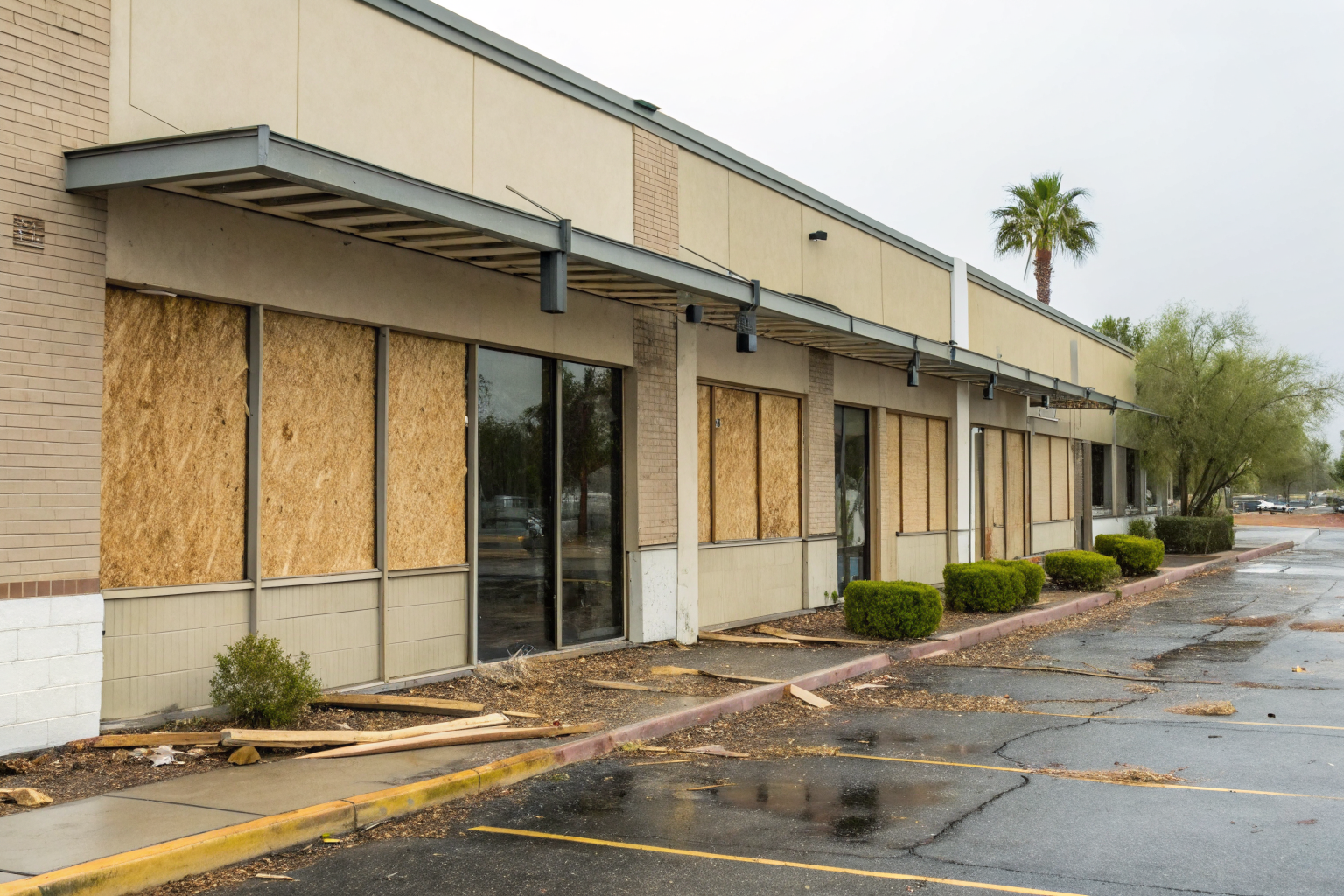
Business interruption coverage requires direct physical loss to covered property as the trigger before lost-income replacement begins under an Arizona commercial policy. Walking through the qualification sequence in order tells you whether a specific monsoon closure generates a payout.
Confirm direct physical loss to covered property. The policy requires the structure itself to sustain physical damage. Ponding with no membrane breach and no interior water intrusion may not meet this threshold, the carrier’s position is that the building was not damaged, only threatened.
Confirm the physical loss forced a necessary suspension of operations. Closing out of caution because water pooled on the roof is not the same as being forced to close because the roof failed and the interior is unsafe. Adjusters distinguish between precautionary closure and compelled closure.
Check the waiting period before BI benefits start. Standard commercial property policies include a 48-72 hour waiting period. A monsoon event that forces a two-day closure sits exactly at that threshold, many Phoenix metro business owners file a BI claim for a two-day closure and receive nothing because the waiting period was never satisfied.
Identify the period of restoration, not actual repair time. The period of restoration is the time a reasonably fast contractor would need to complete repairs, not the time your actual contractor takes. If the adjuster determines a competent roofer could repair the membrane in five days but your contractor takes three weeks due to scheduling, the BI benefit covers five days, not three weeks.
Check for monthly BI limits or coinsurance requirements. Many small commercial policies carry BI limits sized at purchase for a single bad week. AZ monsoon season runs June 15 through September 30 per the National Weather Service, four months of active exposure. Back-to-back events compounding the period of restoration can push the total loss well past a limit that seemed adequate at renewal.
If a claim does move forward, the documentation you preserve in the first 48 hours drives the outcome. The process for documenting a monsoon damage claim correctly is covered step by step in the document monsoon claim arizona article, and that sequence applies to commercial properties as directly as it does to residential ones.
Can You Subrogate Against the Roofing Contractor Who Installed Your Flat Roof?
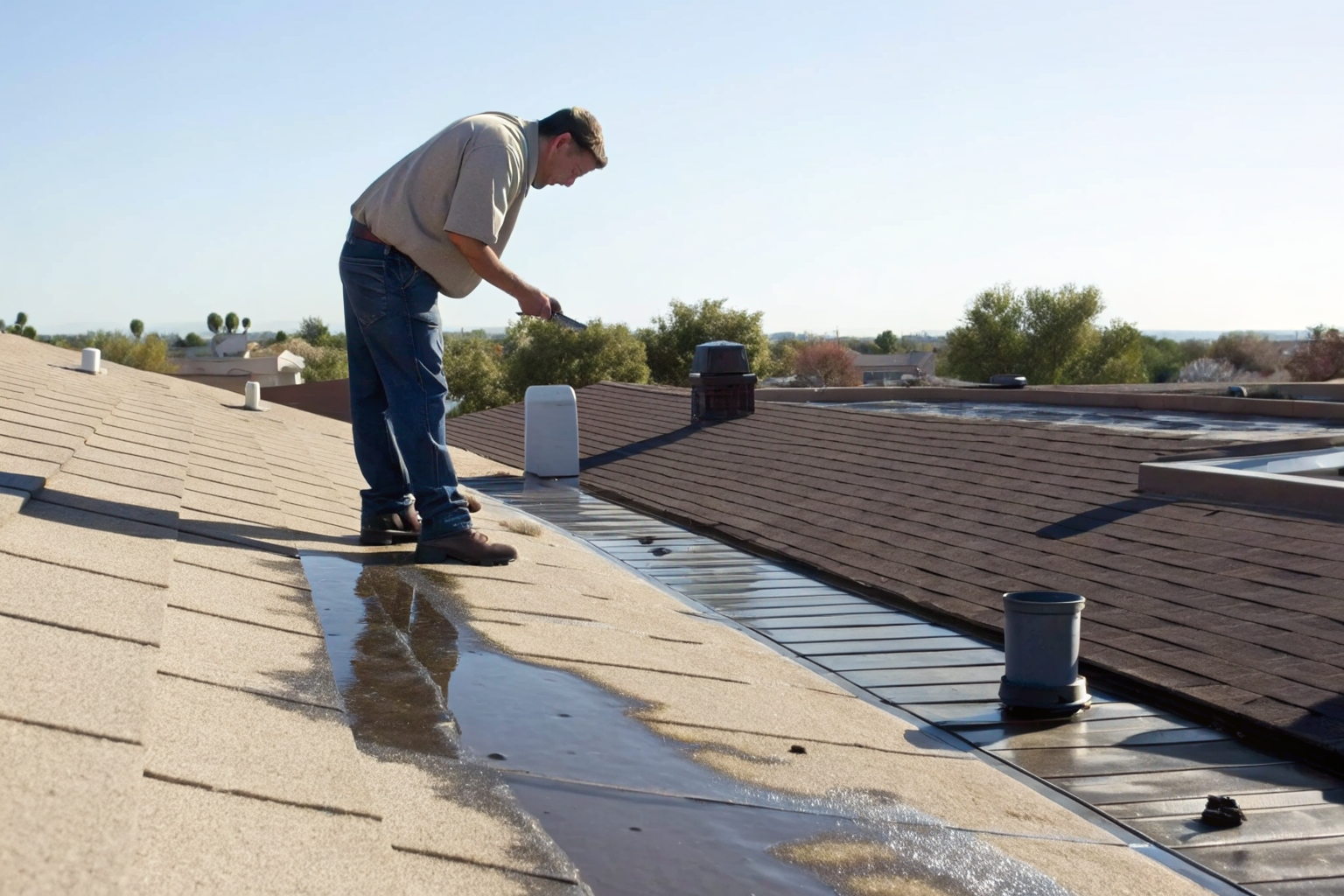
Subrogation is the insurer’s right to stand in the commercial property owner’s shoes and pursue the party whose defective work caused the loss. In a flat-roof ponding scenario, that party is often the roofing contractor whose poor drain placement, incorrect slope, or defective membrane installation created the condition that turned a monsoon into a denied or partially paid claim. Subrogation against installers transfers the paid claim cost to that contractor when installation defect caused the loss, but four conditions must align for the carrier to succeed.
The carrier must have paid the underlying claim. No payment from the carrier means no subrogation rights. If the claim was denied under the gradual-damage exclusion, there is nothing for the carrier to recover on behalf of the insured.
The installation defect must be documented. The carrier needs the original roofing contract, the job specifications, any inspection reports from the installation period, and an expert roofer’s written opinion on the specific defect. Without that chain of documentation, the subrogation demand falls apart.
The contractor’s general liability policy must still be active. Many storm-chaser roofing companies operating in Phoenix metro are shell entities with policies that lapse between jobs. Pursuing subrogation against a contractor with no active coverage produces nothing. Checking the contractor’s certificate of insurance before signing any roofing contract is the only way to avoid this problem on the front end.
The commercial owner must not have waived subrogation in the roofing contract. Many roofing contractor agreements include a subrogation waiver clause. Most property owners sign without reading it. Once that waiver is signed, the carrier loses its right to pursue the contractor regardless of how clear the defect is.
ARS 12-552 gives Arizona a maximum 8-year statute of repose for construction defect claims, but subrogation actions typically must be filed within the carrier’s own policy limitations period, often 3 years from the date of loss. The carrier pursues the subrogation action, not the insured, but the insured must cooperate and preserve all evidence for the carrier to have any chance of recovering.
If your commercial property also has a shared roof structure with an HOA or a multi-tenant arrangement, the question of who carries subrogation rights gets more complicated. The hoa master policy ho-6 gap arizona problem applies in commercial condo settings where the master policy and the individual unit owner’s policy both disclaim responsibility for the same installation defect.
Frequently Asked Questions
Does commercial property insurance in Arizona cover monsoon flood damage?
Standard commercial property policies exclude flood, including flash-flood entry from monsoon events, under the flood exclusion clause. A separate NFIP policy or private flood policy is required to cover that peril, and the NFIP carries a 30-day waiting period that makes any policy purchased after a storm watch is issued useless for that event. Wind-caused roof damage from the same monsoon event is covered under the wind/hail peril, subject to the wind/hail deductible.
How long does business interruption insurance pay out after a monsoon closes my Phoenix business?
Business interruption coverage pays for lost income during the period of restoration, which is the time a reasonably fast contractor would need to complete repairs to the damaged property. Most standard commercial policies include a 48-72 hour waiting period before BI benefits start, so a two-day forced closure from monsoon damage may produce no payout at all. The BI limit on many small commercial policies is also set at purchase without adjustment for business growth, which means the per-month ceiling often falls short of the owner’s actual revenue loss.
What is the wind and hail deductible on a commercial property policy in Phoenix?
Wind and hail deductibles on admitted commercial property policies in the Phoenix metro typically run 1-5% of the building’s total insured value, calculated against the full insured value rather than the amount of the loss. A $600,000 commercial building with a 2% wind/hail deductible means $12,000 out of pocket before the policy pays anything on a monsoon wind claim. This deductible tier is separate from the flat all-other-perils deductible that applies to non-weather claims on the same policy.