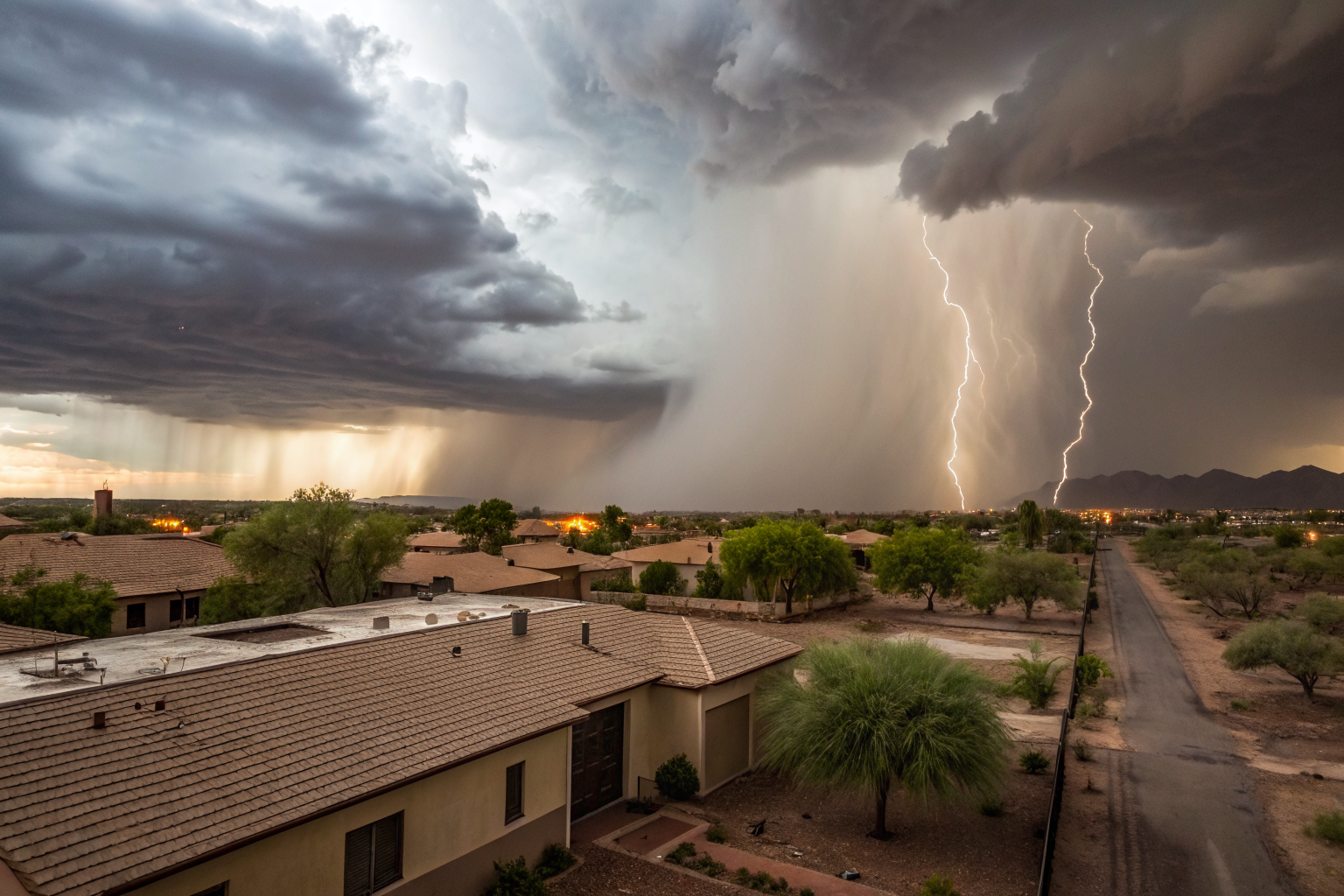
To document a monsoon claim in Arizona correctly, you have roughly 24 hours before the decisions you make start working against you. The storm has cleared. The damage is visible. What you do next determines whether the carrier pays the full covered loss or finds a reason to dispute it.
Key Takeaways:
- Arizona monsoon season runs June through September, carriers expect first notice of loss within 24–72 hours of discovery, not the storm date, but delay past 30 days gives adjusters grounds to question causation.
- Your wind/hail deductible triggers on wind-driven damage; water that entered through ground-level flooding falls under the flash flood exclusion, the same claim can be partially covered and partially excluded depending on how each damage type is categorized.
- The NFIP 30-day waiting period means a flood policy bought after a monsoon event is useless for that storm, homeowners without pre-existing flood coverage must document every damage category precisely to isolate the wind-covered portion.
The First 24 Hours After an Arizona Monsoon Hit: What to Do Before You Touch Anything

First notice of loss triggers the carrier’s claim investigation clock, and in Arizona, that clock starts the moment you discover damage, not the moment the storm hit. That distinction matters. AZ monsoon season runs June through September, and carriers flag any claim filed more than 30 days after the storm date for additional causation review. A roof leak you noticed two weeks after the storm still falls within the coverage window, but your documentation must establish the discovery date on record from the start.
One more separation to make before you take a single photo: wind damage to the structure is a homeowners claim; water that pooled at ground level and entered through doors, garage seals, or low wall openings triggers the flash flood exclusion. These are two distinct damage streams. Mentally separate them from minute one, because how you document them determines which portion the carrier pays.
Perform a safety check before re-entry. Check for downed power lines, gas smell, and structural instability before anyone enters the home. One photo from the street of obvious exterior damage establishes your starting point.
Call your carrier and log first notice of loss the same day. Ask for a claim number and confirm that the date of discovery, not the storm date, is recorded in the file. Write the claim number and the representative’s name on paper.
Do not make permanent repairs before documentation is complete. Nothing gets patched, replaced, or cleaned up until the adjuster has a complete photo and video record of the original damage.
Make emergency-only temporary repairs to stop active damage from spreading. Tarps over breached roofing, a towel against a leaking door frame, boarding a broken window, these are allowed and encouraged. Save every receipt. Temporary mitigation does not void coverage; it protects it.
Photograph the exterior before moving or clearing any debris. Leave fallen tree limbs, blown-off shingles, and displaced flashing exactly where they landed until you have a full photographic record of the scene as the storm left it.
What to Photograph and Record, The Exact Documentation Standard Adjusters Actually Want

Photo and video documentation determines whether disputed damage gets paid or excluded. Adjusters reviewing a contested monsoon claim look for one thing above everything else: the breach point. Roof-level or wall-level damage supports a wind claim. Water entry through doors, garage seals, or ground-level openings triggers flash flood exclusion review. Your visual record must show the difference between the two, because conflating them gives the carrier grounds to exclude more than the policy requires.
Your wind/hail deductible only triggers on the wind-damaged portion of the claim. Clean visual separation of damage categories is not a bureaucratic detail. It is the difference between a paid claim and a disputed one.
Wide establishing shots of each exterior face before debris is moved. Take these from the property corners, four cardinal directions. These shots prove the condition of the structure immediately after the storm, before anything was touched.
Close-up shots of each individual damage point with a reference object for scale. A tape measure or a standard dollar bill placed next to the damage gives the adjuster a size reference they can use in their scope estimate. One shot per damage point, not one shot of the whole roof.
Interior water intrusion shots that show the entry point and travel path, not just the wet drywall. Follow the water from where it entered (ceiling breach, wall penetration, threshold gap) to where it landed. This documentation supports the wind claim when entry was above grade, and isolates the flash flood exclusion when entry was at ground level.
A full video walkthrough with narration. Walk every room affected and say out loud what you are looking at: “Master bedroom ceiling, northwest corner, water staining from roof breach above.” Cardinal directions and room names matter because the adjuster will use your narration to orient their scope.
Timestamped photos taken directly from your phone, no edits, no filters. The metadata embedded in an unedited phone photo includes the date, time, and GPS coordinates. Edited or filtered photos lose that metadata, which gives adjusters room to question when the photos were taken.
Photos of every temporary repair you make, with receipts in frame. Photograph the tarp on the roof with the receipt for the tarp visible in the same shot. This documents both the damage condition and your mitigation effort simultaneously.
A screenshot or printout of the National Weather Service storm record for your date and ZIP code. This is the third-party weather confirmation adjusters use to tie your claim to a named weather event. Without it, a carrier can argue the damage was pre-existing. The NWS storm data archive is publicly accessible at weather.gov.
The Monsoon Claim Documentation Checklist: What to Have Ready Before the Adjuster Arrives

A complete documentation package reduces adjuster-initiated claim delays. Adjusters work through a predictable sequence when they arrive: they verify coverage, confirm the storm event, assess damage scope, check for pre-existing conditions, and calculate the deductible. Every item in the table below addresses one of those steps directly.
One note on the NFIP 30-day waiting period: if you do not already have a flood policy in force, ground-level water intrusion from this monsoon event cannot be submitted to NFIP under any circumstances. A policy purchased after the storm will not cover it. Document that ground-level damage anyway, it establishes the split between the covered wind portion and the excluded flood portion, which protects the wind side of your homeowners claim. If you have questions about whether flood insurance makes sense before next monsoon season, the article on flood insurance for Phoenix monsoon flooding covers when NFIP applies and when it does not.
| Document Type | What It Proves | Where to Get It | Deadline Risk |
|---|---|---|---|
| Timestamped photos and video (unedited) | Damage occurred as described and in the condition reported | Your phone, do not edit or transfer to another app before submitting | Delay past 30 days from storm date invites causation challenges |
| NWS storm record printout | Storm date, intensity, and location on third-party record | weather.gov storm data archive, search by date and ZIP | No hard deadline, but missing this lets the carrier argue pre-existing damage |
| Policy declarations page | Coverage limits, deductible structure, wind/hail deductible split | Your carrier’s online portal or your agent | Needed at first adjuster meeting, get it before the appointment |
| Prior inspection or roof report (if available) | Pre-storm roof condition, counters pre-existing damage arguments | Prior contractor, roofing company, or insurance inspection records | Particularly important for homes with roofs over 15 years old |
| Emergency repair receipts | Temporary mitigation does not void coverage, it is required | Keep paper receipts; photograph them with the repair in frame | Submit with initial claim package, not as an afterthought |
| Contractor damage estimate (itemized) | Scope and cost of loss, itemized by damage cause | Licensed AZ contractor, see Section 4 for quality standards | Needed before the adjuster closes their scope estimate |
| Mortgage lender contact info | Lender may be named on the claim check and must endorse it | Your loan documents or servicer’s website | Delays payment if discovered late in the process |
| NFIP flood policy declarations (if in force) | Flood coverage in effect before the storm date | Your flood insurance carrier or agent | NFIP 30-day waiting period means policies purchased after the event do not apply |
Does Your Contractor Estimate Help or Hurt Your Claim?

Contractor estimate quality directly affects how the carrier scopes and prices the loss. A vague quote gives adjusters room to low-ball the settlement. A claim-ready estimate closes that room.
A usable contractor estimate must do four things. First, it separates labor and materials into distinct line items, not a single total. Second, it identifies the damage cause at each line item: wind uplift, water intrusion, or impact damage get separate entries, not a combined description. Third, it specifies whether replacement or repair is the recommended remedy for each component. Fourth, it uses line-item pricing that matches Xactimate-style scope categories, because that is the software most carrier adjusters use to build their own estimates. When your contractor’s scope matches the adjuster’s format, disputes narrow to price rather than scope.
Watch for storm-chaser roofers. They are common in Arizona after monsoon events, and they push for full roof replacement on every claim regardless of what the actual damage warrants. When a carrier adjuster sees an estimate that recommends replacement on every component from a single storm, that triggers a fraud review, which delays payment on the portions of the claim that were legitimate.
The percentage deductible structure makes accurate scoping a financial necessity, not a preference. On a $500,000 home with a 2% wind/hail deductible, the homeowner covers the first $10,000 out of pocket before the carrier pays anything. A contractor estimate that documents damage clearly above that threshold moves the claim forward. An inflated estimate from a storm chaser can get the entire claim disputed, leaving you with nothing while the review drags on.
Get your own documentation package in place before any contractor speaks with the adjuster. Homeowners who let the contractor negotiate first lose control of how the damage is characterized in the carrier’s file. If your property also has solar panels, note that solar system damage on an undisclosed installation creates a separate coverage question, the topic of solar panel insurance claim denials in Arizona covers how carriers handle that gap.
Should You Hire a Public Adjuster for Your Arizona Monsoon Claim?

A public adjuster is a licensed claims professional hired by the homeowner, not the carrier, to document and negotiate the loss. This means they work for you, not for the company writing the check. They are distinct from the carrier’s adjuster (who represents the carrier’s interests) and from an attorney (who litigates). Arizona public adjusters are licensed by the Arizona Department of Insurance and Financial Institutions (DIFI), homeowners should verify licensure at the DIFI license lookup before signing any contract.
Public adjusters add measurable value in three specific monsoon-claim scenarios. They help when the initial carrier offer is below the contractor’s documented scope by a significant margin. They help when the claim involves a disputed damage-cause split between wind and flood, because they know how to present breach-point evidence in a format that supports the covered portion. And they are worth the cost when the estimated damages clear roughly $25,000 to $30,000, because their contingency fee (typically 10–15% of the settlement) gets recovered in the difference between the carrier’s first offer and the negotiated settlement.
For smaller claims where the dispute is the deductible math rather than the scope of damage, a public adjuster’s fee will likely exceed any recovery they produce. That is not a criticism of the profession; it is arithmetic.
One limit that applies regardless of who argues the claim: a public adjuster cannot override the flash flood exclusion. If ground-level water intrusion is excluded under your policy, it stays excluded. What a public adjuster can do is make sure the wind-covered portion of the loss is fully documented and not undercut by how the flood portion was presented.
For questions about your specific coverage structure before monsoon season, the Arizona insurance guide covers the major coverage categories that apply to desert homeowners, and an independent review of your policy by an agent with access to 200+ carriers can identify gaps before the next storm. Homeowners in the Scottsdale area dealing with similar post-storm questions can find locally-focused guidance through an insurance agency serving Scottsdale that handles the same coverage issues.
Frequently Asked Questions
How long do I have to file a monsoon damage claim in Arizona?
Your homeowners policy sets the specific deadline, but most AZ carriers require prompt reporting, and filing more than 30 days after the storm date gives the adjuster grounds to challenge causation. The date of discovery controls the clock, not the storm date, so document the damage the moment you find it and report it to your carrier the same day. Waiting because the damage appears minor is one of the most common reasons AZ monsoon claims get contested late in the process.
What does ‘document a storm damage claim’ mean, what files do I need?
At minimum: timestamped, unedited photos and video of every damage point before debris is cleared, a printout of the National Weather Service storm record for your date and ZIP code, your policy declarations page showing your deductible structure, and itemized receipts for any emergency repairs. The NWS record is the piece most homeowners skip, and it is the third-party confirmation that ties your claim to a named weather event rather than leaving the carrier room to argue the damage was pre-existing.
Does a monsoon claim in Arizona require a separate checklist from other storm claims?
Yes, because AZ monsoon damage typically involves both wind damage covered under your homeowners policy and ground-level flooding excluded under the flash flood exclusion, often from the same storm. Your documentation must visually separate the two damage streams, breach-point photos at roof or wall level support the wind claim, while ground-entry water is categorized separately. Conflating the two in your documentation gives the carrier grounds to exclude more of the claim than the policy actually requires.
If your property is part of a planned community or condo association, the HOA master policy and HO-6 gap also affects which damages fall under your coverage versus the association’s, worth confirming before the adjuster arrives. Commercial property owners with flat roofs should note that monsoon documentation for commercial flat roof damage follows a similar breach-point logic but with different coverage triggers than a residential HO-3 policy.