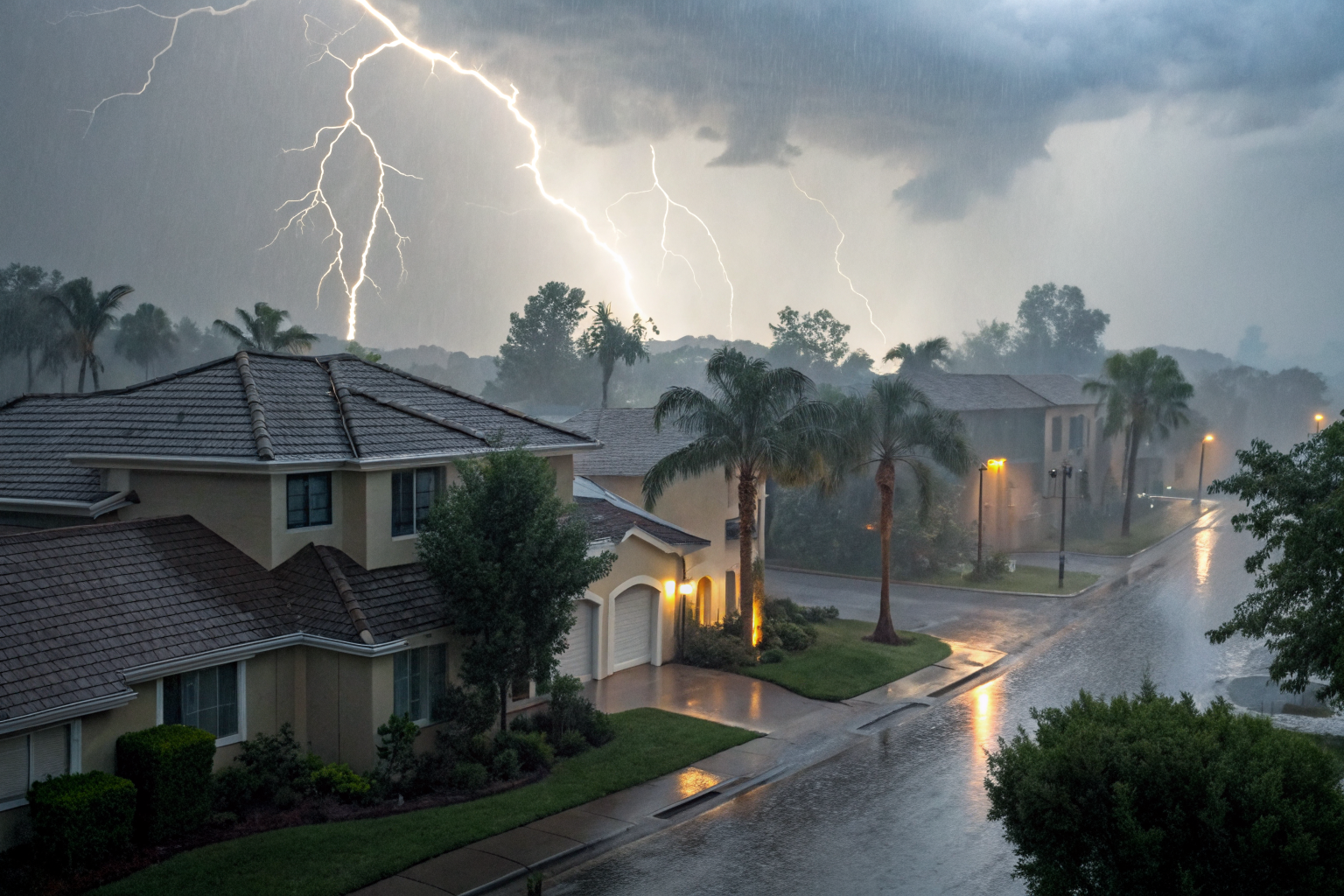
Monsoon deductible Arizona homeowners actually carry is rarely the flat dollar figure printed on the declarations page, and most people find that out the hard way, mid-claim. This article is your entry point into every coverage mechanic that makes AZ monsoon season financially dangerous: percentage deductibles, wind/hail splits, flash flood exclusions, and renewal-cycle resets that raise your exposure without a phone call. For the full arizona insurance guide covering every coverage category statewide, that context lives in the master pillar.
Key Takeaways:
- Arizona weather deductibles run 1–5% of your home’s main coverage (Coverage A), on a $500,000 home at 5%, that’s $25,000 out of pocket before your policy pays a cent.
- Wind and hail perils split onto a separate deductible tier on most filed AZ HO-3 forms, meaning monsoon wind damage triggers the percentage deductible, not the flat all-other-perils deductible.
- Your carrier can reset the percentage deductible upward at renewal without a line-item disclosure that most homeowners would catch, most policyholders find out only when they file a claim.
What Is a Percentage Deductible, and Why Does It Hit Arizona Homeowners So Hard?

A percentage deductible is a deductible that calculates against your home’s Coverage A dwelling limit, not a flat dollar amount. This means the number on your declarations page is not $500 or $1,000, it is 1%, 2%, or 5%, and the dollar figure it produces depends entirely on how much coverage your home is insured for.
Think of it this way: a flat deductible is a fixed toll. A percentage deductible is a toll that grows as your home value grows. Most Arizona homeowners assume the flat-dollar model because that is what auto insurance uses, and the declarations page often shows only the percentage without doing the math for you.
The math, when you run it, is where the sticker shock lives.
| Coverage A (Dwelling Limit) | 1% Deductible | 2% Deductible | 5% Deductible |
|---|---|---|---|
| $300,000 | $3,000 | $6,000 | $15,000 |
| $500,000 | $5,000 | $10,000 | $25,000 |
| $750,000 | $7,500 | $15,000 | $37,500 |
At 5% on a $500,000 Coverage A, the out-of-pocket deductible is $25,000 before the policy pays a single dollar on a wind or hail claim. That is not a policy gap, it is the policy working as written. The gap is that most homeowners never knew.
AZ carriers adopted percentage structures because of wind and hail loss frequency during monsoon season. The June through September monsoon window produces the concentrated weather-loss events that drove underwriters to shift exposure back to policyholders. A flat $1,000 deductible made sense when hail damage was occasional. Once AZ monsoon season became a predictable annual loss driver, carriers filed for percentage structures across the market and regulators approved them.
The AZ monsoon percentage deductible structure is now the default on most standard HO-3 forms filed with DIFI, not an add-on or an exception. If your policy was written or renewed in the last decade and your home is in the Phoenix metro or anywhere in the monsoon corridor, the probability that your weather deductible is a percentage, and not the flat dollar you remember from your first policy, is high. Pull the declarations page before the next storm, not after.
How the Wind/Hail Deductible Split Works, and Which Monsoon Damages Trigger Which Tier

The section most policyholders never read is the deductible structure page. Most homeowners know they have a deductible. Fewer know they have two, structured differently, applying to different perils.
Standard AZ HO-3 forms filed with DIFI split the deductible into at minimum two tiers: (1) wind and hail, expressed as a percentage of Coverage A, and (2) all-other-perils (AOP), expressed as a flat dollar amount. The wind/hail deductible split separates monsoon wind damage from the flat all-other-perils deductible, which means the same storm can trigger two completely different cost calculations depending on what the damage is.
The HOAIC Arizona HO-3 policy form filed with DIFI in March 2025 is the baseline filed form used for AZ market comparisons. It reflects current carrier practice on the split structure.
| Peril | Deductible Tier | Structure | Monsoon-Season Example |
|---|---|---|---|
| Wind-driven rain entering through damaged roof | Wind/Hail | Percentage of Coverage A | Roof membrane torn by 60 mph haboob gusts; rain enters through breach |
| Hail impact on roof tiles or siding | Wind/Hail | Percentage of Coverage A | Golf ball-sized hail cracks tile field across rear slope |
| Non-weather water damage (burst pipe, appliance leak) | All-Other-Perils (AOP) | Flat dollar amount | Supply line failure unrelated to storm event |
| Fire | All-Other-Perils (AOP) | Flat dollar amount | Kitchen fire during power surge from storm |
| Theft | All-Other-Perils (AOP) | Flat dollar amount | Break-in while property is storm-evacuated |
| Flash flood water entering at ground level | Not covered under HO-3 | Excluded peril | Monsoon runoff surging under garage door or through block wall |
The thing most policy guides miss here: wind-driven rain and hail are not the same peril as flood, even when they arrive in the same storm. A monsoon that produces 70 mph gusts, hail, and three inches of rain in forty minutes is delivering three separate insurance events simultaneously. The wind damage triggers the percentage deductible. The water entering through the wind-damaged roof triggers the same percentage deductible because the cause is wind. The water entering through the front door at ground level is excluded entirely.
That third scenario, flash flood damage, is not a deductible question. It is a coverage question. The HO-3 simply does not cover it. Flood coverage requires a separate policy, and that is covered in depth in the section on arizona monsoon insurance exclusions.
For commercial property owners, particularly those with flat roofs that pool water during monsoon storms, the commercial flat roof monsoon damage exposure introduces additional coverage mechanics not present in the residential HO-3 framework.
Does Homeowners Insurance in Arizona Cover Monsoon Damage?

A standard Arizona HO-3 policy covers wind-driven rain and hail but excludes flash flood as a named peril. That single sentence contains the most important coverage distinction in AZ monsoon season, and most homeowners only learn it when a claim is already filed.
Here is how the five most common monsoon damage scenarios play out under a standard HO-3:
Wind-driven rain entering through a damaged roof. Covered, subject to the wind/hail percentage deductible. The cause of the water entry is wind damage to the roof structure. Because the originating peril is wind, the percentage deductible applies, not the flat AOP deductible. The damage to interior ceilings, walls, and flooring that results from that entry is covered.
Hail damage to roof tiles or siding. Covered, subject to the same wind/hail percentage deductible. Arizona tile roofs crack and chip under hail impact, and the repair or replacement cost is covered minus the percentage deductible. One caution: carriers increasingly apply roof-age schedules that depreciate older tile, so actual payout can be lower than replacement cost on an aging roof.
Flash flood water entering under doors, through block walls, or as ground-level surface runoff. Excluded under a standard HO-3. This is not a deductible situation, the policy does not cover this peril at all. Flood coverage requires a separate policy, either through the National Flood Insurance Program or a private flood insurer. The NFIP imposes a standard 30-day waiting period before coverage takes effect, which means buying a flood policy the day a storm is forecast does nothing. The deadline to add flood coverage before AZ monsoon season starts is roughly May 1, not June 1. The mechanics of flood insurance in phoenix monsoon conditions, including NFIP zone mapping and private flood alternatives, go deeper than this overview can.
Haboob dust infiltration damaging HVAC or electronics. Excluded or limited under most standard HO-3 forms. Dust infiltration from a haboob is not a named covered peril. If wind physically damages the HVAC unit, that portion may be covered. Damage caused by dust entering through intact seals is typically not. This is one of the arizona monsoon insurance exclusions most homeowners discover too late.
Fallen tree from wind striking the structure. The structural damage is covered, subject to the wind/hail percentage deductible. Debris removal is covered but subject to a sub-limit, typically $500 to $1,000 per tree, which rarely covers actual removal costs in a large-scale storm event.
The NFIP 30-day waiting period is the rule that turns a coverage gap into a planning problem. You cannot buy your way out of a gap after the storm is on the radar. The document monsoon claim arizona process assumes coverage already exists, there is no claim to document on a peril your policy excludes.
The Renewal-Cycle Deductible Reset: How Your Number Changes Without You Noticing

Your monsoon deductible isn’t $500 anymore. It probably hasn’t been for several renewal cycles. The question is whether you know what it actually is today.
The carrier raised deductible at renewal mechanism works through two vectors, and most policyholders are exposed to both without realizing it.
The first vector is Coverage A inflation indexing. Every year at renewal, most carriers adjust the Coverage A dwelling limit upward to track construction cost inflation or replacement-cost indices. This is presented as a protection, your home is insured for more. What is not explained is that your deductible is a percentage of that limit, so when Coverage A rises, your deductible dollar exposure rises with it, automatically, without anyone changing the percentage.
The second vector is the carrier directly raising the percentage tier itself. ARS 20-1652 governs non-renewal and cancellation notice requirements in Arizona, but a deductible change is a policy modification at renewal, not a cancellation. The disclosure bar for a policy modification is lower than for a non-renewal. Your carrier can move your wind/hail deductible from 2% to 3% at renewal, and the notification is typically buried in the renewal packet alongside dozens of other form changes.
The combined effect is significant. A policyholder who bought a $350,000 home in 2018 with a 2% wind/hail deductible had $7,000 in out-of-pocket exposure. If Coverage A has been indexed to $600,000 and the carrier has moved the percentage to 3%, that same policyholder now carries an $18,000 deductible, without ever receiving a direct phone call, a highlighted notice, or a plain-English explanation. That $11,000 increase is the claim-time surprise.
The Coverage A increase from $350,000 to $600,000 at 3% shifts the wind/hail deductible from $7,000 to $18,000 with no claim, no headline change, and no conversation the homeowner remembers having.
The action step is mechanical and takes about ten minutes. Pull the declarations pages from your two most recent renewals. Compare the Coverage A number. Compare the deductible percentage. If either number changed, and on most AZ policies issued before 2023, at least one did, the dollar exposure changed. An audit of your deductibles across your arizona policy is the kind of pre-season review that prevents claim-time surprises, and the mechanics of how to do that audit are covered in full in a dedicated deductible audit guide.
Deductible Buydown and Monsoon Damage Insurance: What Your Options Are in Arizona

Once you know your actual deductible exposure, the next question is what you can do about it. Three practical levers exist for AZ homeowners who want to reduce monsoon-season financial risk. None of them are free. All of them require action before the storm season, not after.
A deductible buydown endorsement reduces percentage deductible exposure in exchange for a higher annual premium. Not every AZ carrier offers this option, and availability is carrier-appetite dependent. Where it exists, the endorsement either buys the percentage down to a lower tier or converts it to a flat dollar cap. If your current carrier does not offer it, the 200+ carrier network approach to shopping your situation exists precisely for cases like this, one carrier’s appetite may include buydown options that another’s does not.
Here is a structured comparison of the three options:
| Option | What It Covers | Cost Signal | Timing Constraint |
|---|---|---|---|
| Deductible buydown endorsement | Reduces wind/hail percentage deductible to a lower percentage or flat dollar cap | Higher annual premium; varies by carrier and Coverage A amount | Available at policy renewal; request before June |
| Higher AOP flat deductible / lower wind percentage restructure | Shifts premium load, higher flat deductible on non-weather claims funds a lower percentage on wind/hail | Premium-neutral to slight reduction; underwriter-dependent | Available at renewal; not all carriers allow the restructure |
| Separate flood policy (NFIP or private) | Covers flash flood perils excluded under the HO-3 | Separate annual premium; NFIP rates set federally, private flood varies | NFIP 30-day waiting period means the deadline is approximately May 1 for monsoon season coverage |
The NFIP 30-day waiting period means the practical deadline to add flood coverage before AZ monsoon season (June through September) is approximately May 1. After that date, a policy purchased will not cover the first monsoon events of the season.
The higher AOP / lower wind restructure is the option most agents never mention. On some carrier platforms, a homeowner can accept a higher flat deductible on non-weather claims (fire, theft, water damage from a burst pipe) in exchange for a lower percentage tier on wind and hail. Because the flat AOP deductible affects lower-frequency, lower-severity events relative to monsoon wind exposure, some homeowners come out ahead in expected annual cost. Whether your carrier allows this restructure is a direct question to ask at your next renewal.
Deductible buydowns are covered in full in a dedicated deductible buydown guide that walks through carrier availability, endorsement language, and the premium math. The broader monsoon preparedness decision, including whether to add flood coverage and how to time the enrollment window, belongs in the annual-review appointment before June 1, not the morning after the first storm cell appears on radar.
Frequently Asked Questions
What is a wind and hail deductible on an Arizona homeowners policy?
A wind and hail deductible is a separate deductible tier, expressed as a percentage of your home’s Coverage A dwelling limit, that applies when wind or hail is the cause of the damage. On most Arizona HO-3 forms, it runs alongside a flat all-other-perils deductible that covers non-weather events. Because monsoon storms are classified as wind events, the percentage tier is the one that triggers on the vast majority of monsoon season claims, not the flat dollar amount most homeowners assume.
Does homeowners insurance in Arizona cover flash flooding from monsoon storms?
No. Flash flood damage, meaning water that enters the home at ground level during a monsoon storm, is excluded under a standard Arizona HO-3 policy. Covering that peril requires a separate policy through the NFIP or a private flood insurer. The NFIP imposes a 30-day waiting period before coverage takes effect, so a policy purchased after a storm warning is issued will not apply to that event.
How do I find out what my actual monsoon deductible dollar amount is?
Pull your declarations page and locate two figures: the Coverage A dwelling limit and the wind or weather deductible percentage. Multiply the two together, that product is your out-of-pocket exposure on any wind or hail claim before the policy contributes anything. If your declarations page shows only a percentage without converting it to dollars, call your agent and ask for the converted figure in writing, along with confirmation of whether that percentage changed at the last renewal.